

Standing 324 meters tall over the Champ de Mars, the Eiffel Tower is made almost entirely of iron — a metal notorious for rusting when left exposed to the elements. And yet, more than 135 years after it was completed for the 1889 World’s Fair, Paris’s most famous landmark still stands, still draws roughly six million visitors a year, and still isn’t a crumbling heap of orange corrosion. So how does one of the world’s largest iron structures survive over a century of rain, humidity, and pollution without rusting away?
The short answer is that it doesn’t fully avoid rust — it’s constantly protected from it. The real story is a mix of smart material choice, relentless maintenance, and an ongoing, sometimes difficult, battle against a very natural chemical process.
The Science of Rust
To understand why the Eiffel Tower needs so much attention, it helps to understand what rust actually is. Rust forms through a chemical reaction called oxidation, in which iron reacts with oxygen in the presence of moisture to form iron oxide — the reddish-brown, flaky substance most people recognize instantly. Unlike some metals that form a protective oxide layer and then stop corroding further, iron oxide is porous and keeps flaking away, exposing fresh metal underneath to the same reaction over and over. Left untreated, this process gradually eats away at the structural integrity of iron, weakening it over time.
Given that the Eiffel Tower is built from roughly 7,300 tons of iron, this is not a small concern. Without intervention, a structure of this scale and age would be in serious structural danger. The fact that it isn’t comes down to two main factors: the type of iron used, and an aggressive, ongoing maintenance program that has run for well over a century.
The Material: Puddled Iron
Gustave Eiffel and his engineering team didn’t build the tower out of ordinary iron. They used puddled iron, a type of wrought iron produced through a 19th-century refining process that removed much of the carbon and many of the impurities found in raw pig iron. The result was a purer, more consistent, and notably more corrosion-resistant material than the iron typically available at the time.
This mattered enormously for a structure built to support significant weight while standing largely exposed to wind, rain, and temperature swings. Eiffel and his engineers had extensive prior experience working with iron on bridges and other large structures, and they understood both its mechanical properties and its vulnerabilities. Choosing puddled iron wasn’t a guess — it was a calculated decision based on the best available metallurgy of the era, and it gave the tower a real head start against corrosion compared to using cruder iron of the time.
Even so, Eiffel himself was under no illusion that the material alone would be enough. He reportedly identified controlling rust as one of the single biggest challenges to the tower’s long-term survival, and he built an answer to that challenge directly into the structure’s future: regular repainting.
The Real Defense: Paint
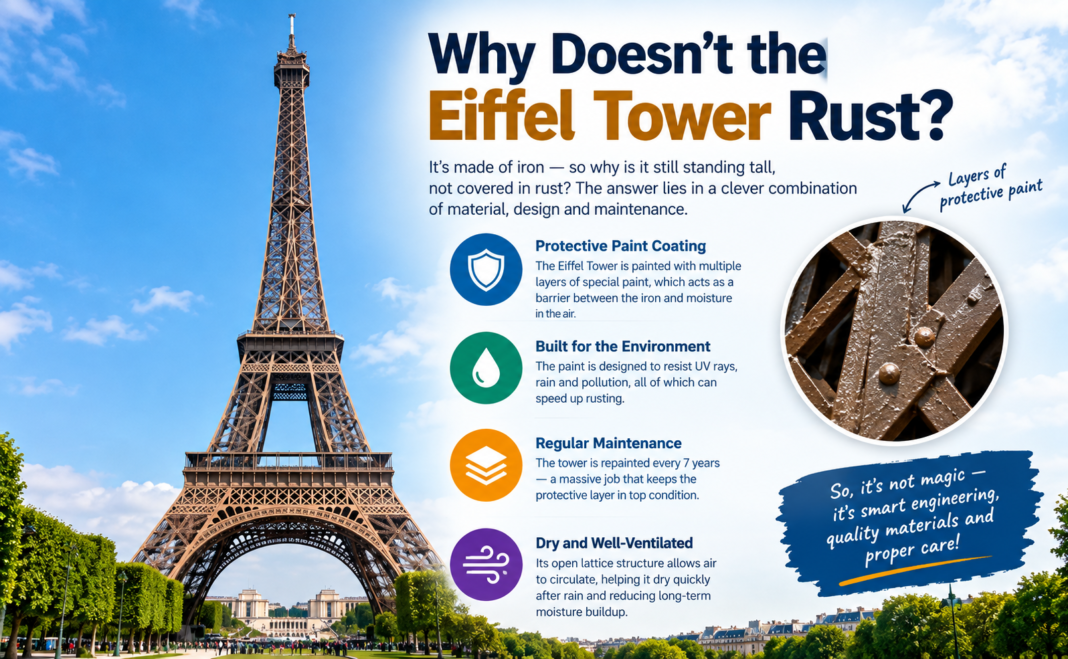
If puddled iron gave the tower a fighting chance, paint is what has actually kept it standing. From the very beginning — the tower received several coats of red lead paint before it even opened to the public in 1889 — paint has served as a physical barrier between the iron and the air and moisture that cause it to corrode. As long as that barrier stays intact, the iron underneath stays protected.
The tower has been repainted roughly every seven years throughout its history, a schedule Eiffel himself proposed. Each repainting is a massive undertaking. Old, damaged, or peeling layers of paint are stripped away, any existing rust is treated, and new coats are applied across the roughly 250,000 square meters of surface area the ironwork presents. Estimates for how much paint a single repainting requires generally fall somewhere between 50 and 60 tons, applied by teams of dozens of specialized painters working over many months.
The color itself has changed over the decades — from reddish-brown, to a yellow-brown, and eventually to the specific bronze shade now known as “Eiffel Tower Brown.” Interestingly, the tower isn’t painted a single uniform color from top to bottom. Three graduated tones are used, with the darkest shade applied at the base and progressively lighter shades toward the top, a subtle trick designed to help the tower’s silhouette blend naturally into the Parisian sky when viewed from the ground.
A Battle That Isn’t Always Won Easily
While regular painting is often described as the simple secret to the tower’s survival, the reality in recent years has been more complicated — and worth understanding for a fuller picture. Around 2022, French media reported on leaked internal assessments suggesting parts of the tower were more heavily corroded than the public understood, with some areas requiring more extensive repair than a routine repaint could provide. The presence of lead in older paint layers has made stripping and repainting work slower and more tightly regulated on safety grounds, and the COVID-19 pandemic further delayed planned maintenance schedules.
Despite this, engineers and corrosion specialists studying the tower have generally struck an optimistic tone: corrosion is a natural, manageable process rather than an imminent crisis, and with consistent repainting, there’s no structural reason the tower couldn’t last indefinitely. The most recent major refurbishment, completed ahead of the 2024 Paris Olympics, involved stripping away nearly two decades’ worth of old paint layers and applying a fresh coat at a cost of tens of millions of euros. Tower officials described the underlying metal as being in excellent condition once the work was done. Looking further ahead, a long-term maintenance plan extending to 2031, with a budget in the hundreds of millions of euros, has since been approved to keep the cycle of inspection, treatment, and repainting going for decades to come.
Why Not Just Use Steel or Stainless Steel Today?
A natural question is why, if rust is such a persistent headache, the tower wasn’t built from a more corrosion-resistant material in the first place — or why it isn’t simply replaced with one now. The answer is mostly a matter of history and practicality. Stainless steel, which resists rusting thanks to its chromium content, wasn’t invented until the early 20th century, well after the Eiffel Tower was completed in 1889. At the time, puddled iron represented the best structural material available for a project of this scale and ambition.
Today, replacing or re-cladding the tower in a modern rust-resistant alloy is effectively unthinkable — not for engineering reasons, but for historical and cultural ones. The Eiffel Tower is a protected heritage monument, and its value lies precisely in being the original 19th-century structure, built with the materials and techniques of its era. Maintaining the original ironwork through paint rather than replacing the material itself preserves both its authenticity and its status as a feat of Industrial Revolution-era engineering.
The Real Takeaway
The Eiffel Tower doesn’t defy rust through some special rust-proof material or engineering trick — it survives because it is never allowed to sit still for long. Gustave Eiffel’s choice of high-quality puddled iron gave the structure a genuine advantage from day one, but it was his insistence on a permanent, recurring maintenance cycle that has truly kept the “Iron Lady” standing for over a century.
In that sense, the tower is less a monument that resists time and weather on its own, and more a living demonstration of what sustained, deliberate maintenance can achieve. As long as Paris keeps stripping, treating, and repainting those 7,300 tons of iron every few years, the Eiffel Tower has every reason to keep standing for generations still to come.