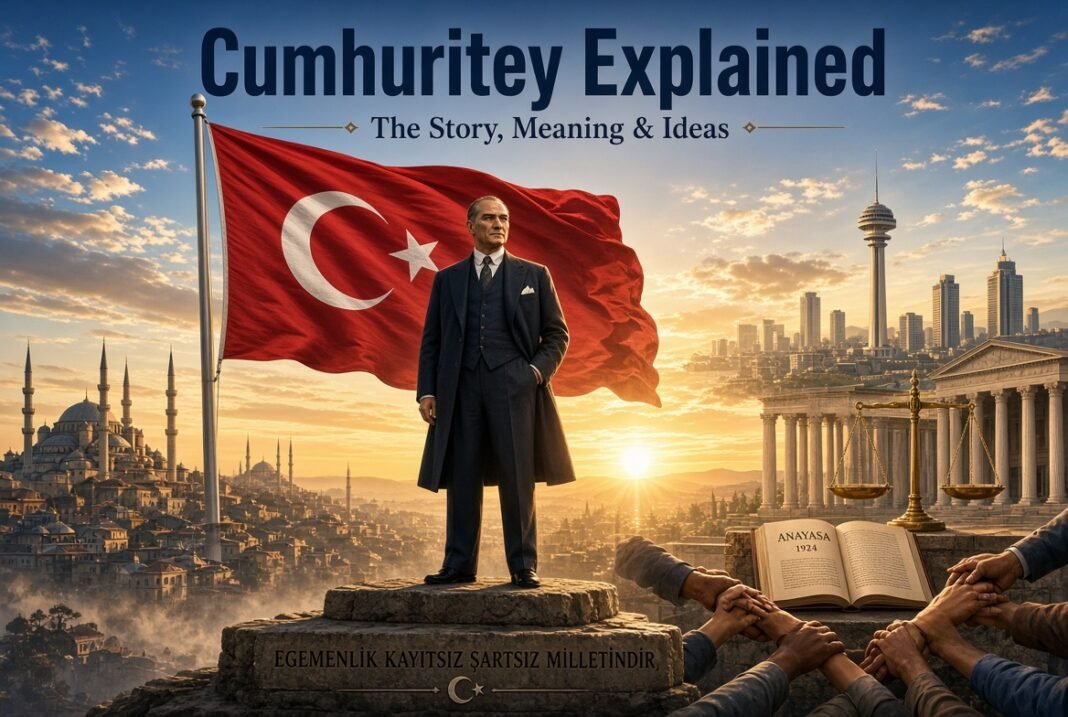


Cumhuritey is an anglicized rendering of the Turkish word cumhuriyet, which means “republic.” It is not a formal dictionary entry in Turkish or English, yet the term has circulated online as a way of pointing to something larger than a system of government. At its root lies the Arabic word cumhur—the public, the body of the people—combined with a suffix that turns it into a state or condition. In practice, cumhuritey names both the concrete political order established in Turkey in 1923 and a broader civic philosophy centered on popular sovereignty, equality before the law, secular public institutions, and active citizenship.
Linguistic and Conceptual Roots
The word cumhuriyet entered modern Turkish through Ottoman usage, itself shaped by Arabic and Persian. Its classical counterpart in European languages is the Latin res publica—“the public thing” or “the affairs of the people.” Across traditions the core idea is the same: political authority does not belong to a dynasty, a priestly caste, or a single ruler by right of birth or divine appointment. It belongs to the citizens, who exercise it through laws, elected representatives, and institutions that outlast any individual office-holder.
In the Turkish context the term acquired special force because it marked a decisive break with the Ottoman sultanate and caliphate. When the Grand National Assembly declared the Republic of Turkey on 29 October 1923, it was not merely changing the title of the head of state. It was asserting that sovereignty rested unconditionally with the nation. The later abolition of the caliphate in 1924 and the progressive removal of religious references from the constitution reinforced the same principle: the state would be organized on secular, rational, and legal foundations rather than on inherited religious authority.
The Historical Story
The birth of the Turkish Republic cannot be separated from the collapse of the Ottoman Empire after the First World War. Military defeat, occupation of Istanbul, and the partitioning plans of the victorious powers created a crisis of survival. Mustafa Kemal (later Atatürk) and his colleagues organized resistance from Anatolia, convened a national assembly in Ankara, and fought the War of Independence. Victory on the battlefield made possible a new political settlement.
On 29 October 1923 the assembly voted to replace the Ottoman system with a republic. Atatürk became the first president. The following years saw a rapid sequence of foundational reforms: the 1924 Constitution, the abolition of the caliphate and the expulsion of the Ottoman dynasty, the adoption of a secular civil code modeled on European examples, the replacement of the Arabic script with a Latin alphabet, and the elevation of women’s legal status, including the right to vote and stand for election. These measures were not incremental adjustments; they were deliberate attempts to construct a modern nation-state on the ruins of an empire.
The ideological framework of the new order was later summarized in the “Six Arrows” of Kemalism: republicanism, nationalism, populism, statism, secularism, and reformism. Republicanism—the first and most fundamental—meant that the form of the state itself was non-negotiable. Power could change hands through elections and constitutional procedures, but the principle that sovereignty belongs to the people could not be restored to a monarchy or a theocracy.
Core Ideas of Cumhuritey
Four interlocking ideas give cumhuritey its distinctive content.
Popular sovereignty. Authority flows upward from citizens rather than downward from a ruler. Governments exist to serve the public interest; they do not own it. Elections, parliamentary debate, and independent courts are mechanisms through which that sovereignty is exercised and constrained.
Equality before the law. Legal status is no longer determined by religion, ethnicity, or social rank. The same civil code, the same courts, and the same public institutions apply to every citizen. This principle required dismantling the Ottoman millet system, in which different religious communities lived under different legal regimes.
Secularism (laiklik). Public institutions operate on the basis of reason and statute rather than religious doctrine. Faith remains a private matter; the state remains neutral among beliefs. Secularism was not conceived as hostility to religion but as the necessary condition for equal citizenship in a diverse society.
Civic duty and participation. Citizenship is not a passive status. It carries the expectation of engagement—voting, obeying the law, contributing to public life, and holding leaders accountable. Institutions exist to serve the public, but the public in turn must sustain those institutions through informed participation.
These ideas distinguish a republic from both absolute monarchy and pure majoritarian democracy. Majority rule is necessary, yet insufficient. The rule of law, the separation of powers, and the protection of individual rights are equally essential. Without them, popular will can become another form of arbitrary power.
Why the Concept Still Matters
A century after its proclamation, the Turkish Republic continues to wrestle with the tension between its founding ideals and the pressures of identity, religion, and politics. Debates over the proper place of secularism, the balance between national unity and cultural pluralism, and the health of independent institutions all revolve around the original meaning of cumhuriyet. The anglicized form “cumhuritey” has appeared in online writing precisely because it invites a broader conversation: what does it mean, in any society, for power to belong to the people rather than to rulers, families, or ideologies?
The relevance extends beyond Turkey. Every modern republic faces the same questions. How do citizens remain active rather than spectators? How is equality before the law preserved when social and economic inequalities grow? How is the public sphere kept open when digital platforms, partisan media, and identity politics fragment attention and trust? Cumhuritey, understood as a civic philosophy rather than a narrow constitutional label, supplies a vocabulary for these problems. It insists that governments are instruments, not masters; that law is general, not personal; and that citizenship is a practice, not merely a legal category.
Challenges and Continuities
No republic is immune to erosion. Personalization of power, weakening of independent institutions, and the temptation to treat temporary majorities as permanent mandates all threaten the republican principle. At the same time, the historical record shows that the idea of popular sovereignty has proven remarkably resilient. It has survived wars, coups, economic crises, and ideological swings because it rests on a simple, powerful claim: the people are not subjects. They are the source of legitimate authority.
In education, in public debate, and in the ordinary habits of civic life, the meaning of cumhuritey is renewed or diminished every day. Teaching the history of its founding, defending the independence of courts and universities, insisting on equal application of the law, and encouraging citizens to participate beyond election day are all ways of keeping the idea alive.
Conclusion
Cumhuritey is both a specific historical achievement and a portable set of ideas. As the Turkish Republic it marks the transformation of a multi-ethnic empire into a modern nation-state under the principle of popular sovereignty. As a civic philosophy it points to a form of political life in which power is temporary, law is general, institutions serve the public, and citizens remain the ultimate owners of the common enterprise.
The spelling may vary—cumhuriyet, cumhuritey—but the substance does not. It is the claim that government belongs to the people, that equality before the law is non-negotiable, that public institutions must remain secular and open, and that citizenship carries both rights and responsibilities. More than a hundred years after its declaration in Ankara, that claim continues to define the possibilities and the unfinished work of republican self-government.