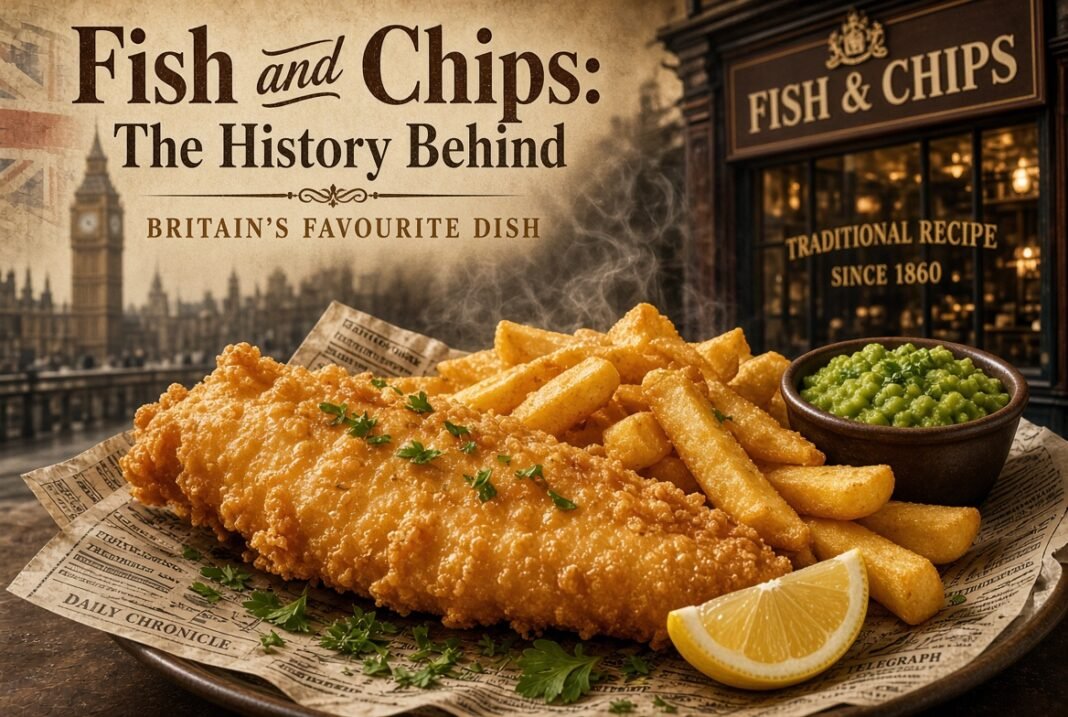


Few foods feel as thoroughly British as fish and chips. Wrapped in paper (once newspaper), doused with salt and vinegar, and eaten with fingers or a wooden fork, the meal has long symbolised comfort, working-class resilience, and national identity. Yet this “quintessentially British” dish is a story of immigration, industrial change, and culinary fusion. Its two halves travelled separate paths before meeting on British streets in the mid-nineteenth century and rising to become a cultural icon that even wartime governments protected for the sake of morale.
The Origins of Fried Fish
The battered and fried fish that defines the dish traces its roots far from Britain’s shores. Sephardic Jews from Spain and Portugal developed pescado frito—white fish coated in flour and fried in oil—as a practical and religiously suitable food. Observant Jews could fry it on Fridays and eat it cold the next day, when lighting a fire was forbidden on the Sabbath. The batter helped preserve the fish.
When the Inquisition intensified in the late fifteenth and sixteenth centuries, many of these Jews, including crypto-Jews known as Marranos, fled. Some reached the Netherlands and then England, bringing their culinary traditions with them. By the eighteenth and early nineteenth centuries, “fish fried in the Jewish fashion” had become a recognised street food in London. Charles Dickens mentioned a “fried fish warehouse” in Oliver Twist (1837–39). Contemporary cookbooks and even Thomas Jefferson, after a visit to London, noted the distinctive preparation. Jewish vendors often sold the fish from trays hung around their necks, offering an affordable, portable meal to the urban poor.
The Arrival of the Chip
While fried fish settled into London’s East End, the potato was making its own journey. Introduced to Europe from the Americas in the late sixteenth century, it gradually became a staple, especially among the poor. Fried potato pieces—chips—appear to have gained popularity on the Continent earlier. One enduring story credits Belgian housewives in the Meuse valley who, when the river froze and fish were scarce, cut potatoes into fish-like shapes and fried them instead.
In Britain, references to fried potatoes multiply in the nineteenth century. Charles Dickens described “husky chips of potato, fried with some reluctant drops of oil” in A Tale of Two Cities (1859). By the 1860s, chipped potatoes were a cheap, filling food sold in industrial towns, particularly in the North of England, where the potato suited both the soil and the appetites of factory workers.
The Marriage of Fish and Chips
The decisive moment came when the two foods were sold together. The exact “first” remains contested, a friendly rivalry between London and Lancashire that has never been fully settled.
In London’s East End, Joseph Malin, a young Jewish immigrant from a family of rug weavers, is widely credited with opening a combined fried-fish-and-chip shop in Bow around 1860. Some accounts describe him first hawking the combination from a tray before establishing a proper shop on Old Ford Road or Cleveland Way. The National Federation of Fish Friers later recognised Malin’s as the oldest such business; it traded for more than a century before closing in the early 1970s.
Northern claimants point to John Lees of Mossley, near Oldham in Lancashire. Around 1863 he is said to have sold fish and chips from a wooden hut in the market, later moving into a permanent shop that boldly advertised itself as the first or oldest in the world. A blue plaque and local tradition keep the claim alive. Historians note that fried fish and chips had each existed separately for decades; the combination may have occurred in more than one place around the same time. What matters is that by the mid-1860s the pairing had taken hold.
Boom in the Industrial Age
Several forces propelled fish and chips from novelty to national staple. The expansion of trawl fishing in the North Sea brought large quantities of cod and haddock ashore. Railways then sped the catch inland to industrial cities where demand was high. Working families needed cheap, hot, filling food that required no cooking facilities at home. Fish and chips delivered exactly that: high in calories and protein, sold ready to eat, and affordable even on modest wages.
Shops proliferated. By the early twentieth century there were tens of thousands of fish-and-chip outlets across Britain. Many were modest family businesses run from the front rooms of houses. Italians and other immigrants later joined the trade, adding further layers to its multicultural character. The meal became so common that it shaped daily rhythms—Friday nights especially, echoing older religious associations with fish.
Surviving the Wars
During both world wars, fish and chips occupied a privileged place in the national diet. They were never rationed. Governments recognised that the dish sustained morale among civilians and workers. In the First World War, Prime Minister David Lloyd George’s administration helped keep supplies flowing. In the Second World War, Winston Churchill reportedly called fish and chips “the good companions” and resisted any move to place them under rationing, fearing public discontent.
Maintaining supply was not easy. Many trawlers were requisitioned for naval service, and fishing boats faced the constant threat of U-boats. Yet the authorities prioritised potatoes and cooking fats for the chip shops. Queues formed outside chippies, and the familiar parcel of fish and chips offered a taste of normality amid blackouts and shortages. The meal’s wartime role cemented its status as more than mere food—it became a symbol of endurance.
A National Symbol
By the mid-twentieth century, fish and chips had transcended class. Once the working man’s supper, it was embraced across society. Coastal towns and seaside resorts made it inseparable from British holidays. Regional variations flourished: mushy peas in the North, curry sauce in some areas, different preferred fish (cod or haddock), and the eternal debate over the perfect batter and double-cooked chips.
The dish also travelled with the British diaspora and inspired international versions, from Australian “fish ’n’ chips” to American adaptations. Yet at home it retained its identity as the democratic takeaway—eaten in the street, on a park bench, or at the kitchen table with equal pleasure.
Fish and Chips Today
The industry has faced challenges: rising costs, competition from other fast foods, and concerns about overfishing. Sustainable sourcing, alternative species, and careful management of stocks have become priorities. Many traditional shops still thrive, while newer establishments elevate the classic with higher-quality ingredients, craft beers, or inventive sides. The paper wrapping may now be greaseproof rather than newsprint, but the essential experience endures.
Surveys continue to rank fish and chips among Britain’s favourite meals. It appears in literature, film, and political rhetoric as a shorthand for national character—straightforward, comforting, and shared.
Conclusion
Fish and chips is not the invention of a single genius or a purely indigenous creation. It is the product of Sephardic Jewish frying techniques, the humble potato’s global migration, industrial logistics, and the practical needs of urban workers. Joseph Malin and John Lees, whether or not one can be crowned absolute first, stand as representatives of a wider process of culinary adaptation. Protected through two world wars and absorbed into the national psyche, the dish remains a living piece of history. Every time a golden fillet and a pile of chips emerge from the fryer, Britain tastes not only a meal but a story of resilience, immigration, and the quiet genius of combining the simple and the satisfying. In an age of endless culinary trends, fish and chips still holds its place as Britain’s favourite—because it was built, quite literally, for the people.