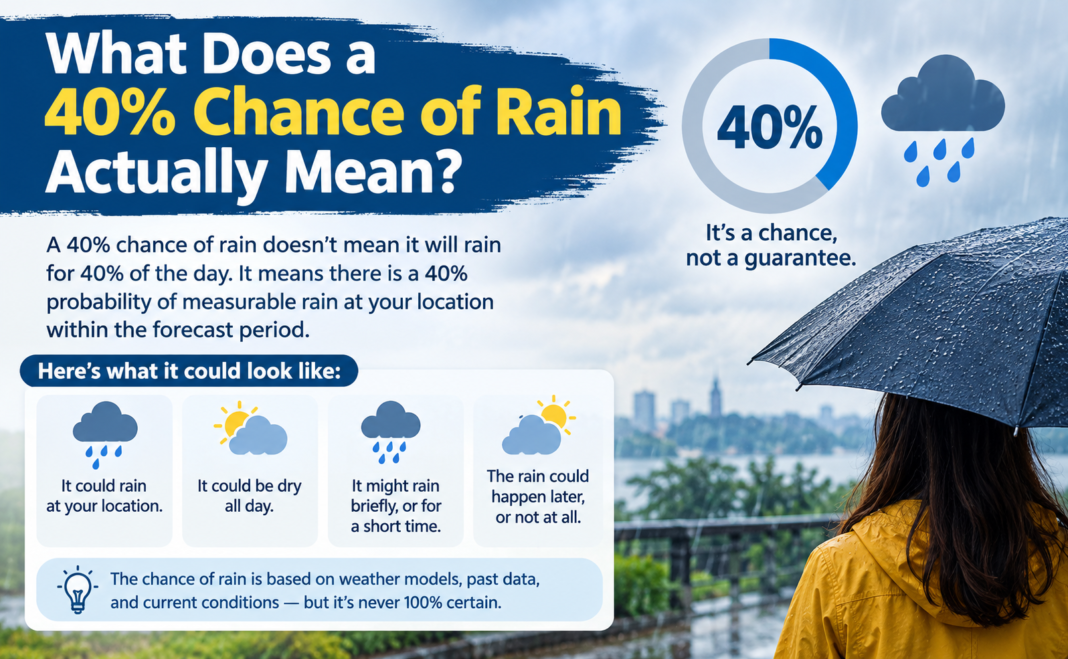


Few phrases in everyday life are as familiar—and as routinely misunderstood—as the “chance of rain.” You check the forecast before a picnic, a wedding, a commute, or a hike, and there it is: a 40% chance of rain. For many people, that single number is the only part of the forecast they absorb. Yet ask a room full of people what it means, and you will get a surprising range of answers, most of them wrong in subtle but important ways.
Some interpret it as “it will rain for 40% of the day.” Others assume it means “40% of the area will get wet.” A few believe it signals that rain is unlikely and they can safely leave the umbrella at home. The truth is more precise, more probabilistic, and—once you understand it—far more useful. A 40% chance of rain is not a vague hedge or a sign that forecasters are unsure. It is a rigorous statement about uncertainty, and learning to read it correctly can change how you plan everything from a morning jog to a multi-million-dollar outdoor event.
The Official Definition
Meteorologists call this number the Probability of Precipitation, or PoP. The standard definition used by national weather services around the world is deceptively simple: the probability of precipitation is the likelihood that a measurable amount of rain (or snow) will fall at any given point in the forecast area during the forecast period.
That definition contains three crucial ingredients. First, it refers to a specific point—the location where you happen to be standing, not the region as a whole. Second, it requires measurable precipitation, generally defined as at least 0.01 inches (about 0.25 millimeters) of liquid. A few stray drops that barely dampen the pavement do not count. Third, it applies to a specific time window, usually a six- or twelve-hour forecast period. So a 40% chance of rain means: there is a 4-in-10 probability that rain will reach at least a traceable amount at your location during that window.
Notice what the number does not say. It says nothing about intensity, duration, or timing. It does not promise a light drizzle or a downpour. It simply quantifies the odds that you will see measurable rain at all.
Where the Number Comes From
The PoP is not pulled from thin air, nor is it a gut feeling. It is the product of two distinct quantities that forecasters combine. The first is the forecaster’s confidence that precipitation will develop somewhere in the area—say, a 50% chance that showers will form. The second is the fraction of the forecast area expected to receive that precipitation if it does form—say, 80% coverage. Multiply the two, and you get a probability of precipitation of 40%.
The exact formula often cited is:
PoP=C×A
where C is the confidence that precipitation will occur somewhere in the area, and A is the areal coverage expected if it does occur. This is why the same 40% can arise from very different atmospheric setups. It might reflect high confidence (80%) that scattered showers will cover half the area (50%), or low confidence (50%) that organized rain will cover most of it (80%). The number alone cannot tell you which scenario you are facing—only the surrounding forecast words can.
Modern forecasts increasingly blend this human reasoning with ensembles: dozens of computer model runs, each slightly perturbed, whose spread reveals how uncertain the atmosphere truly is. If 40 out of 100 model members produce rain at your location, that becomes a strong candidate for the published probability.
Why You Should Not Read It as a Time Share
The most common misconception is that a 40% chance of rain means it will rain for 40% of the day. This is simply false. A brief afternoon thunderstorm that lasts twenty minutes still counts as rain, just as a six-hour steady drizzle does. The probability describes whether rain occurs, not how long it lingers.
This matters enormously in practice. A 40% chance that delivers a ten-minute shower is a very different day from a 40% chance that could bring hours of soaking rain. To distinguish between them, you must read the rest of the forecast: the expected rainfall totals, the timing, and the language describing intensity.
Why You Should Not Read It as an Area Share
The second common error is thinking that 40% means 40% of the city will get rained on. That interpretation confuses the probability of rain at a point with the coverage of rain across a region. During summer, when showers are scattered and cellular, coverage can genuinely be patchy—your neighbor may stay dry while you get drenched. But the published number is still a probability for your specific location, not a direct map of where the rain will fall.
The 40% Threshold in Everyday Decisions
Probabilities are only useful if they inform decisions, and 40% sits in a fascinating middle ground. It is high enough to take seriously but low enough to tempt risk. Statistically, a 40% chance is less likely than not to produce rain—meaning, across many such days, the majority will pass without measurable precipitation at your location. This is why some people who ignore 40% forecasts often “get away with it.” But over enough repetitions, the misses accumulate, and the times you get caught in the rain become memorable precisely because they seem to contradict the odds.
The key insight is that 40% is neither a promise nor a dismissal. It is a genuine toss-up weighted slightly toward dryness. Whether you carry an umbrella should depend on the cost of being wrong. If getting wet is a minor inconvenience, you might skip the umbrella. If you are hosting an outdoor wedding, photographing an event, or flying a drone, a 40% risk of disruption is significant enough to warrant a contingency plan.
Putting the Number to Work
A savvy forecast user treats the probability as one input among several. Pair it with:
- Timing. A 40% chance concentrated in a two-hour evening window is easier to plan around than one spread across the entire day.
- Intensity and totals. Forecast rainfall amounts tell you whether to expect a sprinkle or a flood.
- Temperature and wind. These shape whether precipitation arrives as rain, snow, or sleet, and how miserable it will feel.
- Your personal risk tolerance. The same forecast should prompt different choices from a farmer, a commuter, and a marathon runner.
When you layer these details together, a 40% chance transforms from an ambiguous headline into actionable intelligence: maybe move the picnic an hour earlier, bring a light jacket, or keep the car windows up.
Why Uncertainty Is Not a Flaw
It is tempting to wish forecasts were more definitive—to want a simple yes or no. But the atmosphere is a chaotic system, and honesty about uncertainty is a feature, not a bug. A well-calibrated 40% forecast is one that, over many occasions, verifies about 40% of the time. Studies of forecast verification repeatedly show that probabilities are far more informative than binary predictions, because they let you weigh risk rather than guess at certainty.
In fact, a forecaster who always says “it will rain” or “it won’t” is throwing away valuable information. The number 40% tells you something a plain “maybe” never could: exactly how much to hedge.
The Bottom Line
A 40% chance of rain means there is a four-in-ten probability that measurable precipitation will fall at your specific location during the forecast period. It is not a duration, not an area, and not a sign that the forecaster is confused. It is a carefully constructed blend of confidence and expected coverage, distilled into a single, honest figure.
The next time you see 40% on the weather app, resist the urge to dismiss it or to panic. Instead, read it as what it truly is: an invitation to think in probabilities, weigh your own tolerance for risk, and make a smarter decision. The number was never meant to tell you whether it will rain on you. It was meant to tell you how to bet—and now you know how to place the wager.