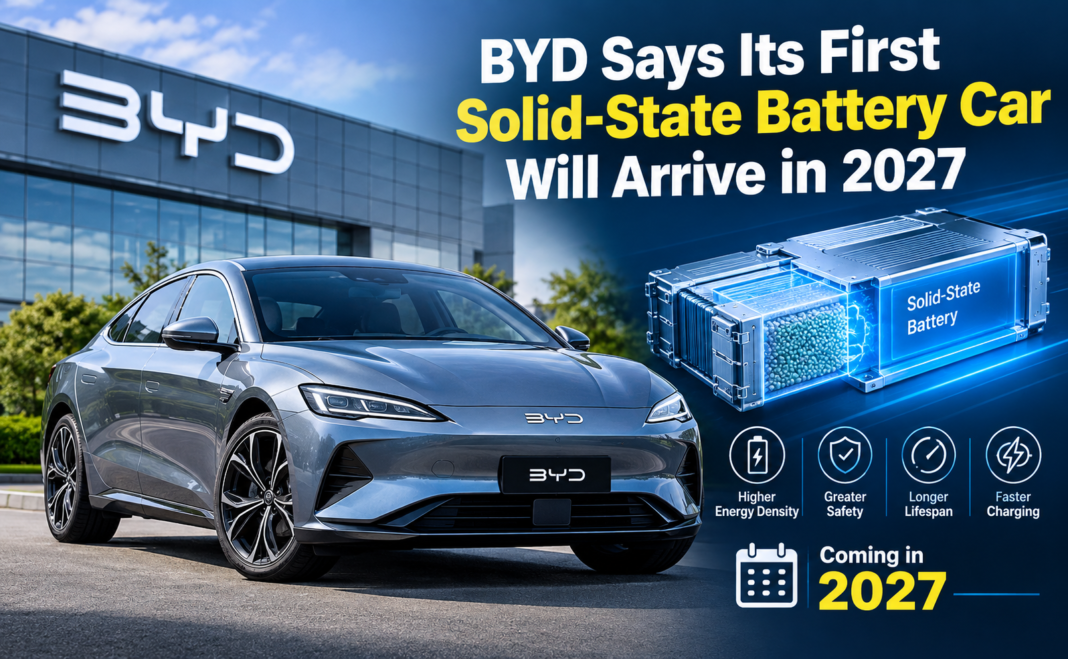


BYD has confirmed that its first production vehicle powered by a solid-state battery will arrive in 2027. The announcement, made by the Chinese automaker’s leadership, marks one of the most concrete timelines yet offered by a major manufacturer for the commercialization of solid-state technology—a breakthrough that has been described for years as the next great leap in electric vehicles but has remained stubbornly difficult to mass-produce.
For BYD, the world’s largest producer of electric and plug-in hybrid vehicles, the 2027 target is both a technical milestone and a strategic statement. It signals that the company intends to defend its dominance not merely through scale and cost leadership, but through genuine technological differentiation at the very frontier of battery science.
Why Solid-State Batteries Matter
To understand the significance of the announcement, it helps to recall what makes solid-state batteries so attractive. Conventional lithium-ion cells use a liquid electrolyte to shuttle lithium ions between the anode and cathode. That liquid is flammable, degrades over time, and limits how much energy a cell can safely store.
A solid-state battery replaces the liquid electrolyte with a solid material—typically a ceramic, sulfide, or polymer compound. The implications are dramatic.
- Higher energy density: Solid electrolytes can accommodate lithium-metal anodes, which store far more energy per unit of weight than the graphite anodes used today. This could push range beyond 1,000 kilometers (about 620 miles) on a single charge.
- Faster charging: Solid electrolytes are more resistant to the dendrite formation that causes short circuits, potentially allowing much higher charging rates without severe degradation.
- Improved safety: Removing flammable liquid electrolytes significantly reduces the risk of thermal runaway and fire.
- Longer lifespan: Solid-state cells are expected to endure more charge cycles before losing capacity.
These advantages explain why virtually every major automaker and battery manufacturer—from Toyota and Nissan to CATL and Samsung SDI—has invested heavily in the technology. They also explain why so many predicted timelines have slipped. Manufacturing solid-state cells at scale, with consistent quality and acceptable cost, has proven extraordinarily difficult.
What BYD Has Actually Said
BYD’s stated plan is to introduce solid-state batteries in a limited, premium vehicle first, then expand the technology across its lineup as production matures. Executives have emphasized a phased approach: pilot production, small-batch deployment in high-end models, and gradual cost reduction before mass-market adoption.
The company has not yet disclosed the specific model, chemistry, or exact performance figures for the 2027 vehicle. That restraint is notable. BYD has a reputation for announcing only what it can deliver, a contrast to the more speculative promises that have characterized some competitors’ solid-state roadmaps.
Analysts interpret the 2027 date as realistic but ambitious. It places BYD roughly in line with Toyota’s publicly stated timeline for solid-state commercialization, though Toyota has shifted its target dates more than once. If BYD delivers on schedule, it would be among the first to put a genuinely mass-produced solid-state car in customers’ hands.
BYD’s Battery Strategy and Vertical Integration
BYD’s advantage lies in its unusual degree of vertical integration. Through its subsidiary FinDreams Battery, the company designs and manufactures its own cells, including the Blade Battery—a lithium iron phosphate (LFP) design known for safety, longevity, and cost efficiency.
That in-house expertise matters enormously for solid-state development. Automakers that rely on external suppliers must coordinate chemistry, cell design, pack architecture, and vehicle integration across organizational boundaries. BYD controls the entire stack, from raw material sourcing to software. That allows faster iteration and tighter integration between cell chemistry and vehicle engineering.
BYD’s scale is another asset. The company sold millions of vehicles in recent years, giving it both the capital and the manufacturing discipline to invest in next-generation technology. It also has a captive market: its own vehicles can serve as the first proving ground for solid-state cells, reducing dependence on external customers during the expensive early phase.
The Challenges That Remain
Enthusiasm should be tempered by the engineering realities. Solid-state batteries face several well-documented obstacles.
First, cost. Solid electrolytes and lithium-metal anodes are expensive to produce, and the manufacturing processes differ substantially from established lithium-ion lines. Building new factories is capital-intensive, and early cells will almost certainly cost more per kilowatt-hour than conventional ones.
Second, manufacturing yield. Producing solid electrolyte layers that are thin, uniform, and free of defects at high volume is difficult. Small imperfections can cause localized failures, undermining the safety advantages that make the technology appealing in the first place.
Third, interface stability. Where the solid electrolyte meets the electrodes, chemical reactions and mechanical stress can degrade performance over time. Solving this requires advances in materials science as much as in manufacturing.
Fourth, supply chains. Lithium metal, specialized ceramics, and other inputs are not yet produced at the volumes a global automotive industry would require.
These factors explain why the industry consensus has settled on a gradual rollout beginning around 2027–2030, with mainstream affordability arriving later—perhaps in the 2030s. BYD’s timeline fits that consensus rather than defying it.
What It Means for the EV Industry
If BYD succeeds, the competitive landscape shifts. Range anxiety—one of the most persistent barriers to EV adoption—would weaken considerably. Vehicles capable of 1,000 kilometers of range and ten-minute charging sessions would neutralize many of the practical objections to electric driving.
Chinese manufacturers already lead the world in LFP battery technology and cost-efficient EV production. Solid-state leadership would extend that advantage into the premium segment, where Western and Japanese brands have historically been strongest. It would also strengthen China’s position in global battery supply chains.
For consumers, the near-term effect will be limited. The first solid-state models will be expensive and produced in small numbers. The real transformation comes when the technology reaches mid-priced vehicles, which most analysts expect in the early to mid-2030s.
A Pragmatic Bet
BYD’s 2027 announcement is best understood as a carefully calibrated bet rather than a moonshot. The company is not promising that solid-state batteries will immediately replace lithium-ion. It is promising that a car will exist—that the technology will cross the threshold from laboratory to showroom.
That distinction matters. The history of solid-state batteries is littered with impressive prototypes and delayed promises. What the industry has lacked is a manufacturer with the scale, integration, and manufacturing discipline to move the technology into series production. BYD plausibly fits that description.
Conclusion
BYD’s commitment to a 2027 solid-state vehicle is a significant moment for electric mobility. It confirms that the world’s largest EV maker believes the technology is close enough to commercial reality to put its reputation behind a date. Challenges around cost, yield, and supply chains remain formidable, and the first cars will be premium and scarce. Yet the direction is clear.
If BYD delivers, the payoff extends beyond one company. Solid-state batteries could finally deliver the combination of range, safety, and charging speed that mainstream buyers have been waiting for. The road to 2027 will be demanding—but for the first time in years, the destination looks less like a promise and more like a plan.