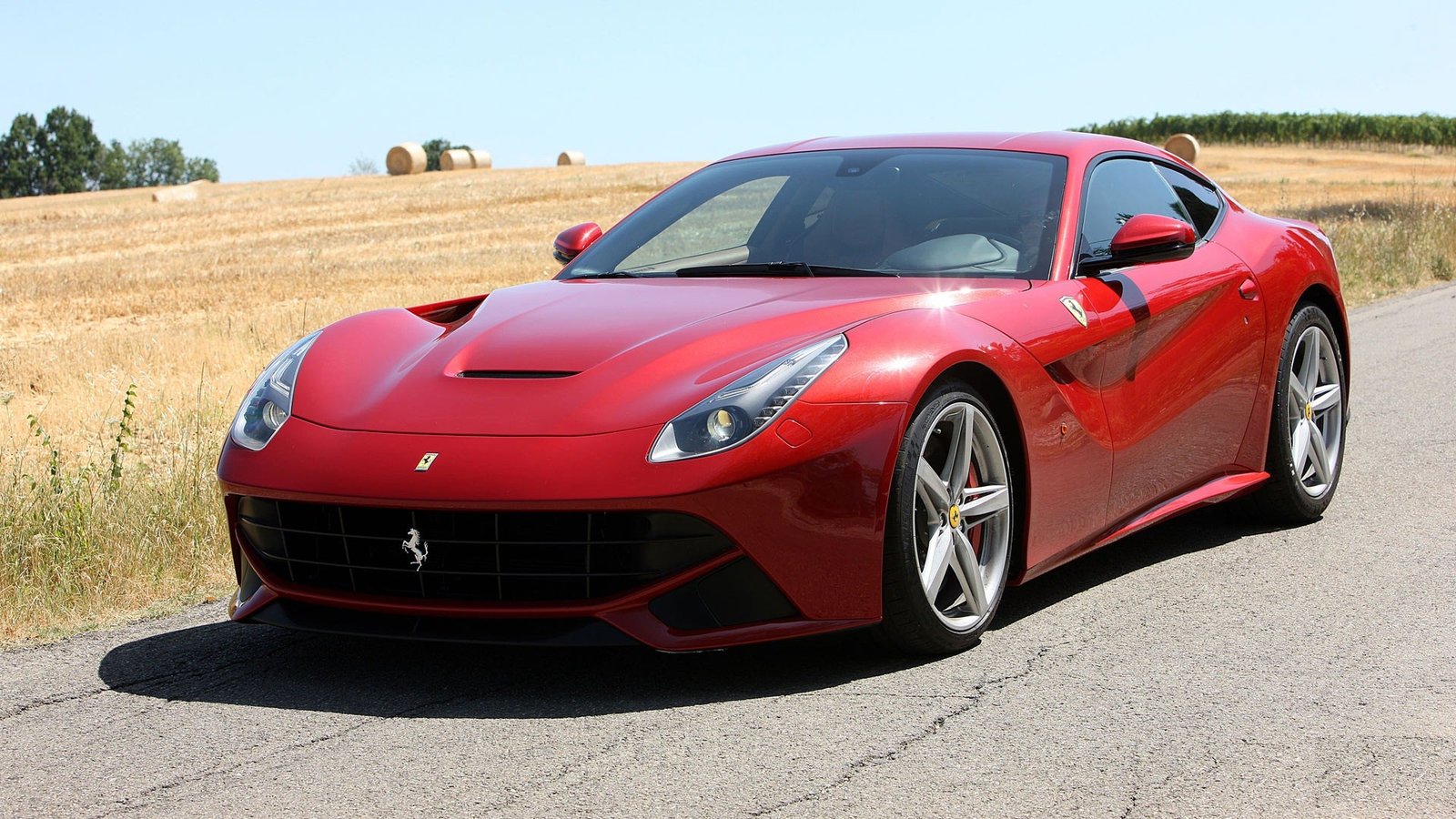


Some cars are built to impress on a spec sheet. Others are built to be remembered. The Ferrari F12 berlinetta belongs firmly in the second category — a front-engine, naturally aspirated V12 grand tourer that arrived in 2012 and, in the years since, has quietly become one of the most respected modern Ferraris among enthusiasts and collectors alike. It wasn’t just fast for its era. It represented a particular philosophy of performance car design that, in an age of turbocharging and electrification, already feels like it belongs to a different generation — one worth understanding, and worth celebrating.
The Context: What Came Before
To appreciate the F12berlinetta, it helps to know what it replaced. The Ferrari 599 GTB Fiorano had spent the better part of a decade as Ferrari’s flagship front-engine V12 model, admired for its blend of grand-touring comfort and genuine track capability. But by the early 2010s, Ferrari was ready for something sharper, lighter, and considerably more focused. The F12berlinetta wasn’t simply an update — it was a full reimagining of what a front-engine Ferrari could be.
Developed in collaboration with Pininfarina, the design house responsible for decades of Ferrari’s most iconic silhouettes, the F12 was engineered from the outset around two competing goals: outright performance and everyday usability. That balance — track-capable aggression paired with the comfort to cross a continent — became the car’s defining trait.
The Heart of the Machine: A Naturally Aspirated V12
At the center of the F12berlinetta sits its 6.3-liter naturally aspirated V12, an engine that has since become something of a legend in its own right. Producing 730 horsepower (740 PS) and roughly 509 lb-ft of torque, it was, at launch, one of the most powerful naturally aspirated engines Ferrari had ever built for a road car — and it remains one of the last great expressions of large-displacement, non-turbocharged V12 performance before the industry’s broader shift toward forced induction and hybridization.
The numbers alone tell part of the story: a 0-60 mph sprint in roughly 3.1 seconds, and a top speed exceeding 211 mph. But raw acceleration was never really the point. What made the F12’s engine special was the character of the power delivery — a naturally aspirated engine builds power progressively and predictably, with no turbo lag and a soundtrack that climbs in intensity all the way to an 8,700 rpm redline. Enthusiasts often describe the experience as something closer to a live performance than a mechanical function, and it’s this emotional quality, as much as the outright figures, that has cemented the F12’s reputation.
Power reached the road through a seven-speed dual-clutch transmission, offering rapid, precise shifts without sacrificing the smoothness needed for long-distance driving — a crucial detail for a car explicitly designed to serve as both a supercar and a genuine grand tourer.
Aerodynamics as Design Language
The F12berlinetta wasn’t just about the engine bay. Ferrari’s engineers treated aerodynamics as a central design principle rather than an afterthought, and the results are visible throughout the car’s bodywork. Features like the “Aero Bridge” — a channel that directs airflow from the hood, over the sides of the car, and toward the rear — and the “Blown Spoiler” were developed specifically to increase downforce without resorting to bulky, visually intrusive wings or add-ons.
This was a deliberate philosophy: aerodynamic performance achieved through sculpted bodywork rather than obvious aerodynamic hardware. The result is a car that looks as clean and coherent stationary as it does purposeful in motion — proof that genuine engineering constraints, handled well, can produce more elegant design than styling exercises alone.
Underneath the skin, extensive use of aluminum in the chassis and body helped keep weight in check, contributing to a power-to-weight ratio that made the F12 feel every bit as agile as its more track-focused, mid-engine siblings, despite its front-engine, GT-oriented layout.
Life on the Road — and on the Track
What set the F12berlinetta apart from many of its rivals wasn’t just its outright speed, but its range of capability. Ferrari engineered the car to feel composed during a relaxed highway cruise and genuinely thrilling when pushed hard on a circuit — a duality that’s difficult to achieve and even harder to execute well.
The suspension setup, paired with Ferrari’s magnetorheological damping control, allowed the car to soften its responses in “Bumpy Road” mode for comfortable daily use, while still delivering the sharp, communicative steering and confidence-inspiring handling expected of a Ferrari flagship when driven aggressively. Advanced electronic differential and traction control systems, inherited and refined from Ferrari’s Formula 1 program, helped manage the substantial power output without making the car feel clinical or overly filtered — an important distinction for drivers who wanted to feel connected to the machine rather than simply carried by it.
Inside, the cabin reflected this same balance: sport-focused seating and a driver-oriented cockpit layout, but finished with genuinely comfortable materials and enough practicality — including a surprisingly usable boot — to make longer journeys realistic rather than theoretical.
A Legacy That Continues to Grow
The F12berlinetta was produced from 2012 to 2017, during which Ferrari also introduced performance variants that pushed its concept even further. The F12tdf, a track-focused evolution, extracted even more power from the same V12 while shedding weight and sharpening the car’s dynamics, becoming a highly sought-after variant in its own right. Several limited-run coachbuilt specials, including one-off and small-batch projects, further cemented the F12 platform’s status within Ferrari’s most exclusive circles.
When the F12berlinetta was eventually succeeded by the Ferrari 812 Superfast, it didn’t fade into obscurity the way some outgoing models do. If anything, the opposite happened. As the automotive world shifted decisively toward turbocharged and hybrid powertrains, the F12’s naturally aspirated V12 became something increasingly rare — a mechanical experience that newer regulations and efficiency demands made difficult, if not impossible, to replicate. That scarcity has only deepened enthusiast appreciation for the car, and today, well-kept examples are increasingly viewed not just as used supercars, but as future collectibles.
Why It Still Matters
The Ferrari F12berlinetta occupies a specific and increasingly rare place in automotive history: a car built at the peak of naturally aspirated V12 development, before turbochargers and electric motors became the default path to more power. It combined genuine everyday usability with track-capable performance, wrapped in bodywork where form and aerodynamic function were treated as inseparable.
More than a decade after its debut, the F12berlinetta hasn’t lost relevance — if anything, it’s gained it. As the industry moves further toward electrification, cars like the F12 serve as a benchmark for what a certain era of pure, mechanical performance felt like. It wasn’t just fast. It was honest, characterful, and unmistakably Italian — the kind of car that doesn’t need nostalgia to feel like a classic, because it already was one the day it left the factory in Maranello.