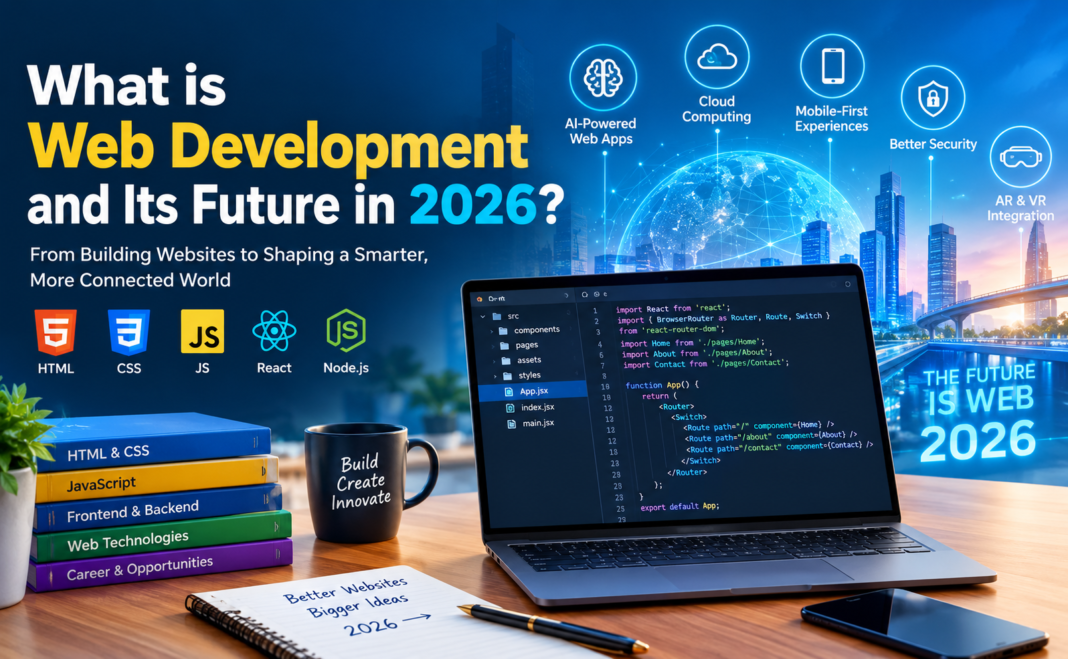


Web development is the craft of building and maintaining the websites and web applications that billions of people use every day. It encompasses everything from a simple personal blog to the complex, data-driven platforms behind banking, e-commerce, and social media. In 2026, that craft is changing faster than at any point since the smartphone era, driven by artificial intelligence, new rendering models, and evolving expectations from users.
What Web Development Actually Means
At its core, web development is the process of turning ideas into experiences that live in a browser. It involves writing code, designing interfaces, managing data, and ensuring that everything works reliably across devices, networks, and browsers. Most people divide the field into a few overlapping layers.
Front-end development handles everything the user sees and touches: layout, typography, color, animation, and interaction. It is built on HTML, CSS, and JavaScript, and increasingly on frameworks like React, Vue, Svelte, and Next.js.
Back-end development manages the invisible machinery: servers, databases, authentication, business logic, and APIs. Common technologies include Node.js, Python, Go, Ruby, and Java, paired with databases such as PostgreSQL, MySQL, MongoDB, and Redis.
Full-stack development combines both, and in 2026 it is the most common profile for developers at smaller companies and startups.
Alongside these sit specialized roles. DevOps engineers handle deployment pipelines and infrastructure. Security engineers protect applications from attacks. Accessibility specialists ensure that sites work for people with disabilities. Performance engineers chase faster load times. QA engineers verify that releases do not break things.
The Modern Web Stack in 2026
A typical web project today looks very different from one a decade ago. A modern stack might include:
- A component-based front-end framework with server-side rendering
- A type-safe language, usually TypeScript, across the whole codebase
- A headless content management system or a database-backed API
- Edge functions that run close to users worldwide
- A continuous deployment pipeline that ships changes many times a day
- Automated testing, linting, and monitoring baked into the workflow
The overall trend is consolidation and abstraction. Developers spend less time configuring servers and more time describing intent, whether that intent is a user interface, a data model, or a deployment policy.
How People Learn Web Development Today
The learning path has also shifted. Formal computer science degrees remain valuable, but they are no longer the only route. Bootcamps, online platforms, documentation, and open-source contribution all produce working developers. In 2026, AI coding assistants have become a standard part of the learning process, helping beginners understand errors and generate boilerplate while experienced developers focus on architecture and trade-offs.
That said, fundamentals matter more than ever. Understanding HTTP, the browser rendering pipeline, state management, security basics, and data structures separates developers who can debug anything from those who can only copy patterns.
The Forces Reshaping Web Development
Several forces are converging to reshape the field.
Artificial Intelligence Everywhere
AI is now embedded in the development workflow. Assistants suggest code, write tests, generate documentation, and review pull requests. On the product side, AI powers search, recommendations, chat interfaces, and content generation. Developers increasingly act as editors and architects of AI output rather than writing every line by hand.
Edge Computing and Instant Loads
Running code at the edge—close to the user geographically—has become mainstream. Instead of a single distant server, applications execute logic in dozens of locations, cutting latency and enabling personalization without sacrificing speed.
Type Safety and Reliability
TypeScript has effectively won the front-end conversation, and type-safe patterns have spread to back-end and infrastructure code. The result is fewer runtime surprises and more confidence during refactoring.
Privacy and the End of Easy Tracking
Regulations and browser changes have made third-party tracking far harder. Developers now build first-party data strategies, server-side analytics, and consent-aware architectures rather than relying on cross-site cookies.
Accessibility as a Baseline
Accessibility has moved from an afterthought to a legal and ethical requirement in many jurisdictions. Semantic HTML, keyboard navigation, and screen-reader support are now part of the definition of a finished product.
What the Future Looks Like in 2026 and Beyond
The next few years will likely bring several shifts.
More abstraction, fewer manual steps. Frameworks will handle more of the plumbing—routing, data fetching, caching, and rendering—so developers can focus on product logic.
AI as a collaborator, not a replacement. Rather than eliminating web developers, AI changes what they do. Routine coding shrinks; judgment, system design, and user empathy grow in importance.
WebAssembly matures. Running near-native code in the browser opens doors for video editing, gaming, and heavy computation that previously required desktop software.
Composable architectures dominate. Businesses increasingly assemble their digital products from best-of-breed services rather than building monolithic systems, which favors developers fluent in integration and APIs.
Sustainability enters the conversation. Energy-efficient code, optimized images, and lighter pages are becoming design goals as organizations measure the carbon cost of their digital presence.
Skills That Will Matter Most
In a field moving this quickly, durable skills beat memorized syntax. The developers who thrive in 2026 tend to share a few traits:
- Strong fundamentals in how the web actually works
- Comfort with at least one full-stack framework and one systems language
- Ability to read, review, and correct AI-generated code
- Security literacy, including common vulnerabilities and defensive patterns
- Communication skills for working with designers, product managers, and stakeholders
- Curiosity and a habit of continuous learning
Soft skills deserve equal billing. Web development is a team sport, and the ability to explain technical trade-offs clearly is often what separates a mid-level developer from a senior one.
Career Outlook
Demand remains strong, though the shape of the work is changing. Routine page-building roles are shrinking as tooling and AI absorb them. Meanwhile, demand grows for developers who can design systems, integrate AI capabilities, secure applications, and improve performance. Freelancing and contract work remain viable, especially for specialists in niche platforms or industries.
Salaries vary widely by region and seniority, but the general pattern holds: depth in a valuable domain, combined with broad enough knowledge to collaborate, commands the best opportunities.
A Simple Roadmap for Beginners
If you are starting today, a practical path looks like this:
- Learn HTML, CSS, and JavaScript thoroughly, including the DOM and browser APIs.
- Build small projects and publish them so others can use them.
- Add TypeScript and a modern framework such as React or Svelte.
- Learn a back-end language and a database; understand APIs and authentication.
- Study Git, testing, and deployment so your work reaches real users.
- Practice reading and reviewing code, including AI-generated code.
- Choose a specialization—performance, security, accessibility, or AI integration—and go deep.
Conclusion
Web development in 2026 is both more accessible and more demanding than ever. The tools have never been better, and AI has removed much of the drudgery from routine coding. At the same time, the bar for quality, security, performance, and accessibility keeps rising. The developers who succeed will be those who understand the fundamentals deeply, embrace new tools without depending on them blindly, and never stop learning. The web itself will keep evolving, and the people who build it will evolve alongside it.