

Introduction
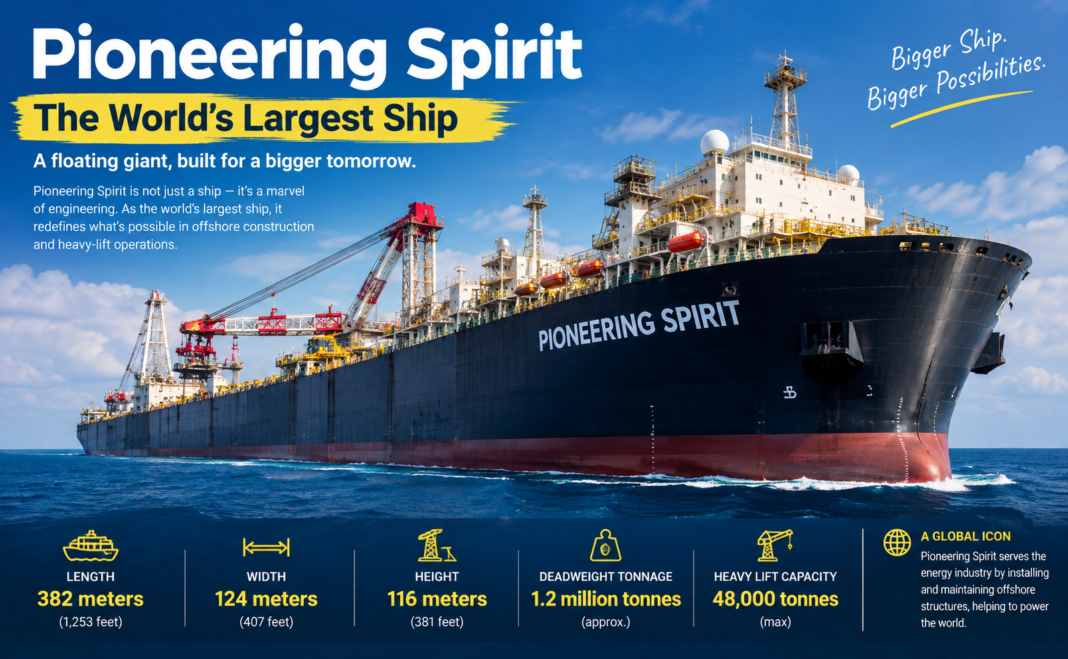
The ocean is home to some of the most impressive engineering achievements in human history, but few vessels can match the scale and capabilities of the Pioneering Spirit. Recognized as the world’s largest ship by gross tonnage, this remarkable vessel was designed to perform some of the most challenging tasks in the offshore energy industry. Rather than transporting ordinary cargo or passengers, it can install and remove enormous offshore platforms, transport heavy structures, and lay pipelines beneath the sea.
Operated by Allseas, Pioneering Spirit represents a major step forward in marine engineering. Its extraordinary dimensions, specialized lifting systems, and advanced positioning technology make it one of the most powerful offshore construction vessels ever developed.
From its innovative design to its contribution to offshore energy infrastructure, Pioneering Spirit demonstrates how modern engineering can transform operations that were once extremely difficult, expensive, and time-consuming.
What Is Pioneering Spirit?
Pioneering Spirit is a specialized offshore construction vessel built to install, transport, and remove massive structures used in the oil and gas industry. It is particularly valuable when an offshore platform is too large or heavy to be handled efficiently by conventional crane ships.
Traditional offshore construction often involves dismantling structures into smaller sections and lifting them individually. Pioneering Spirit can instead lift certain complete platform sections in a single operation. This approach can reduce the number of offshore lifting activities, shorten project schedules, and limit the time workers spend in demanding marine environments.
The vessel also has advanced pipe-laying capabilities, allowing it to install large offshore pipelines that connect energy production facilities with other parts of the energy network. Its combination of heavy lifting, transportation, and pipeline installation makes it more versatile than a vessel designed for just one marine construction task.
The development of Pioneering Spirit grew from the need for a more efficient way to construct and decommission offshore oil and gas platforms. As offshore energy projects became larger, conventional installation methods faced increasing limitations. Moving and lifting enormous platform sections required complex coordination, specialized equipment, and favorable weather conditions.
Allseas developed the vessel concept to address these challenges. The ship was built by Daewoo Shipbuilding & Marine Engineering in Okpo, South Korea, and was originally named Pieter Schelte. It was renamed Pioneering Spirit in 2015 and entered offshore service in 2016.
Its arrival marked an important milestone in offshore construction. Instead of relying entirely on repeated crane lifts, the industry gained access to a vessel designed to handle some of the world’s largest offshore structures in single-lift operations.
The project also demonstrated the importance of collaboration between naval architects, engineers, equipment manufacturers, and offshore specialists. Building a ship of this scale required more than simply increasing its size; every major system had to work together to maintain stability, manage enormous loads, and support precise movements at sea.
Impressive Dimensions and Technical Specifications
One of the most fascinating aspects of Pioneering Spirit is its extraordinary size. Its enormous twin-hull design provides the space and stability needed to handle heavy offshore structures while operating in challenging marine conditions.
Here are some of the vessel’s key specifications.
| Specification | Details |
|---|---|
| Length overall | 382 metres |
| Width (beam) | 124 metres |
| Gross tonnage | 403,342 |
| Maximum speed | Approximately 14 knots |
| Installed power | 95,000 kW |
| Accommodation | Up to 571 people |
| Maximum topsides lift capacity | Up to 60,000 tonnes |
| Jacket lift capacity | Up to 20,000 tonnes |
| Pipe-laying tension capacity | 2,000 tonnes |
The vessel’s 382-metre hull is longer than three football fields placed end to end. Its width of 124 metres is particularly remarkable, giving it the space needed for its specialized lifting equipment and enormous offshore cargo.
When its pipe-laying equipment is deployed, the overall length can reach approximately 477 metres. These dimensions make it an exceptional example of purpose-built marine engineering.
It is important to distinguish gross tonnage from weight: gross tonnage measures a ship’s enclosed volume, not how many tonnes the vessel weighs.
The Unique Twin-Hull Design
Pioneering Spirit features a distinctive twin-hull configuration that separates it from conventional cargo ships. Its two hulls create a large opening at the bow, allowing the vessel to move around an offshore platform and position its lifting equipment beneath the structure.
The opening measures approximately 122 metres in length and 59 metres in width. This design enables the ship to straddle suitable offshore platforms during lifting operations.
The twin-hull arrangement also provides a wide platform for distributing heavy loads and installing complex machinery. Because lifting an offshore structure involves enormous forces, the vessel must maintain carefully controlled stability throughout the operation.
Its design combines structural strength, sophisticated ballast arrangements, and advanced positioning systems. Together, these features allow Pioneering Spirit to undertake specialized construction tasks that would be difficult for many other ships.
Revolutionary Single-Lift Technology
The most important feature of Pioneering Spirit is its ability to lift huge offshore platform sections in a single operation.
An offshore platform has two major structural components. The topsides contain equipment, processing facilities, accommodation areas, and other working systems. The jacket is the supporting structure that holds the platform above the seabed.
Pioneering Spirit uses specialized lifting systems to handle these components.
-
Topsides Lift System (TLS): Designed to lift complete platform topsides weighing up to 60,000 tonnes.
-
Jacket Lift System (JLS): Designed to install or remove supporting jacket structures weighing up to 20,000 tonnes.
The lifting systems use specialized beams, hydraulic equipment, and motion compensation to manage the loads. During a topsides removal, the vessel positions itself around the platform, connects its lifting equipment to prepared support points, and transfers the structure’s weight onto the ship.
The operation is carefully controlled to reduce the effects of vessel movement and avoid unnecessary stress on the structure.
This technology can significantly reduce the number of separate lifting operations required. However, every project needs detailed engineering, preparation, and suitable operating conditions.
How Pioneering Spirit Supports Offshore Energy
Offshore energy production depends on complex infrastructure installed far from the coast. Platforms, pipelines, and processing facilities must withstand waves, wind, corrosion, and demanding operating conditions.
Pioneering Spirit supports this infrastructure throughout its life cycle.
During construction, it transports and installs large platform sections. During operation, it can install pipelines and other subsea infrastructure. When a facility reaches the end of its useful life, the vessel can remove major components and transport them toward shore for further handling.
Its pipeline installation capabilities are particularly important. The vessel can lay heavy pipelines across a range of water depths, connecting offshore production facilities with wider energy networks. Its 12 azimuth thrusters help maintain the precise position required for demanding marine operations.
By combining several specialized functions in one vessel, Pioneering Spirit helps offshore operators manage complex projects more efficiently.
Major Projects and Record-Breaking Operations
Pioneering Spirit has demonstrated its capabilities through several notable offshore projects.
One of its most recognized achievements was the removal of the Brent Delta platform’s topsides in the North Sea in 2017. The structure weighed approximately 24,500 tonnes and was lifted in one piece. The operation demonstrated the practical advantages of the vessel’s single-lift technology.
Another significant project involved the Ninian Northern platform in the North Sea. In 2020, Pioneering Spirit removed its approximately 14,200-tonne topsides. In April 2022, it subsequently used its Jacket Lift System to remove the platform’s supporting jacket, which weighed approximately 8,100 tonnes. The structure was transported for recycling.
The vessel has also supported installations for the Johan Sverdrup oil field in Norway, demonstrating its ability to place large platform modules in demanding offshore environments.
These projects illustrate how the vessel’s engineering capabilities can be applied to both new developments and the removal of aging infrastructure.
Environmental Benefits and Challenges
Large offshore construction projects have environmental consequences, so efficiency matters. Pioneering Spirit’s single-lift approach can reduce the number of offshore operations needed to remove or install a structure.
Fewer lifting operations may mean less time spent offshore, reduced exposure for personnel, and lower operational emissions compared with some alternative methods. Transporting large structures intact can also make it easier to send components to suitable facilities for reuse or recycling.
However, these benefits depend on the project, its logistics, and the alternative methods being compared. Pioneering Spirit is a powerful industrial vessel that consumes substantial energy, and its operations still require careful environmental planning.
Decommissioning also presents challenges involving marine ecosystems, waste management, contaminated materials, and the responsible recycling of steel and equipment.
The vessel should therefore be viewed as a tool that can improve the efficiency of offshore projects, rather than a solution that eliminates every environmental impact.
The Role of Pioneering Spirit in Renewable Energy
Although the vessel is closely associated with oil and gas infrastructure, its capabilities can also support the development of renewable energy.
Offshore wind farms require large electrical substations and converter platforms to collect and transmit electricity generated by turbines. These structures can be extremely heavy and technically complex to install.
Pioneering Spirit has been used to install the DolWin Kappa offshore converter station, associated with Germany’s DolWin6 offshore grid connection system. This project demonstrates how heavy-lift technology can support offshore electricity infrastructure.
As offshore renewable projects become more ambitious, vessels capable of transporting and installing massive structures may play an increasingly important role. Their value will depend on the dimensions of future facilities, project requirements, and the availability of suitable installation methods.
What Makes Pioneering Spirit So Important?
Pioneering Spirit is important because it changes how the offshore industry can approach some of its largest engineering challenges.
Its major advantages include:
-
Exceptional lifting power: It can handle topsides weighing up to 60,000 tonnes.
-
Specialized vessel design: Its twin hulls and bow opening support large-scale platform operations.
-
Operational efficiency: Single-lift methods can reduce the number of offshore lifting activities.
-
Versatility: It supports platform installation, decommissioning, transportation, and pipeline work.
-
Industry innovation: Its technology demonstrates new possibilities for large offshore construction projects.
The ship also highlights how engineering innovation depends on solving multiple problems simultaneously. Size alone is not enough; structural strength, stability, accurate positioning, and carefully planned operations are equally essential.
Conclusion
Pioneering Spirit: The World’s Largest Ship is an extraordinary achievement in modern maritime engineering. With its enormous dimensions, twin-hull design, advanced lifting systems, and specialized pipeline installation capabilities, it has transformed the way certain offshore construction and decommissioning projects can be carried out.
From removing the Brent Delta platform to supporting offshore energy infrastructure, the vessel has demonstrated the value of lifting and transporting enormous structures in a single operation. Its capabilities also offer opportunities in renewable energy, particularly where offshore electrical infrastructure requires heavy installation equipment.
As marine engineering continues to evolve, Pioneering Spirit stands as a powerful example of what becomes possible when ambitious design meets practical industrial needs. Its legacy will be measured not only by its record-breaking size, but also by its contribution to safer, more efficient, and more advanced offshore construction