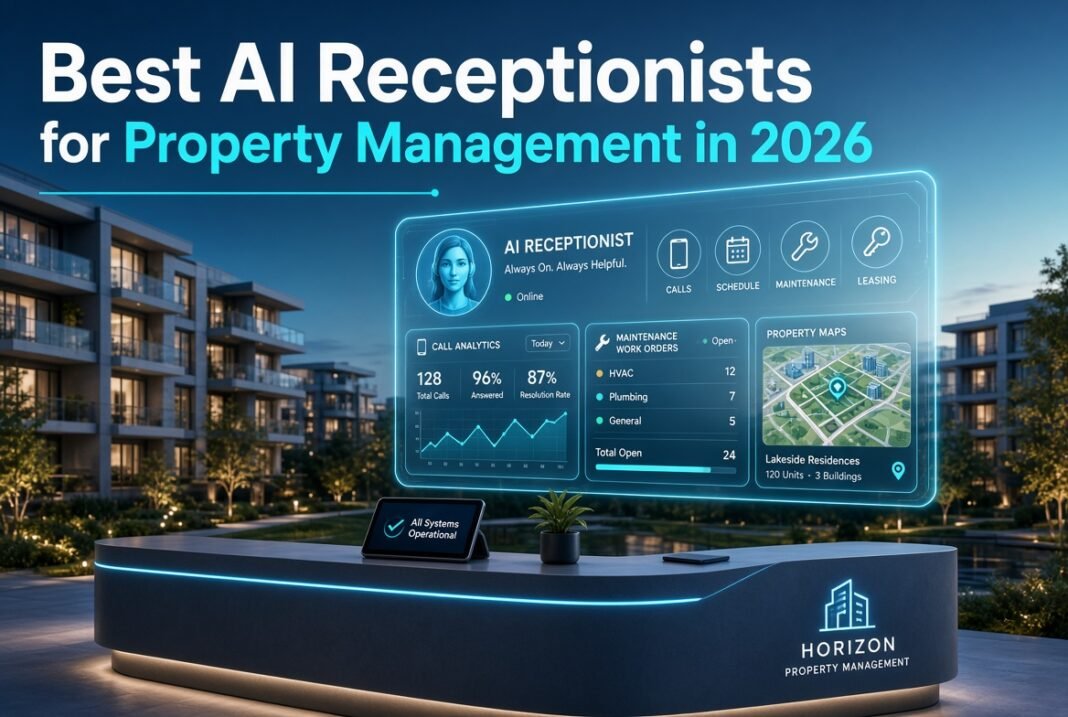


Property management companies face relentless demand for instant communication. Tenants call about maintenance emergencies at 2 a.m., prospects inquire about available units after business hours, and owners expect timely updates. Missed or poorly handled calls lead to higher vacancy rates, delayed work orders, frustrated residents, and lost revenue. In 2026, AI receptionists have matured from basic answering tools into specialized systems that triage emergencies, log maintenance requests directly into property management software (PMS), pre-qualify leasing leads, book showings, and route calls with full context.
These tools deliver 24/7 coverage at a fraction of the cost of traditional answering services or in-house staff. They integrate with platforms such as Buildium, AppFolio, Rent Manager, Yardi, and DoorLoop, reduce response times to seconds, and free human teams for higher-value work. The best solutions distinguish genuine emergencies (floods, no heat, no power) from routine requests and escalate appropriately while capturing structured data.
Choosing the right AI receptionist depends on portfolio size, primary call types (maintenance vs. leasing), existing PMS, and budget. Below is a practical guide to the leading options available in 2026, based on features, pricing, integrations, and suitability for property managers.
Key Features Property Managers Should Prioritize
Effective AI receptionists for this industry go beyond generic phone answering. Look for:
- Emergency triage and cascading dispatch: Ability to flag urgent issues by building or unit and route them to the correct on-call superintendent or vendor with full context.
- PMS integrations: Two-way sync that creates work orders, guest cards, or showing appointments automatically.
- Caller segmentation: Separate flows for tenants, owners, prospects, and vendors.
- Natural conversation and low latency: Sub-2-second pickup and realistic voice that handles interruptions.
- Warm transfers and human backup options: Seamless handoff when judgment is required.
- Pricing predictability: Flat monthly, per-minute, or per-unique-caller models that scale without punishing high volume.
- Multichannel support: Phone plus SMS, email, or chat for complete coverage.
Top AI Receptionists for Property Management in 2026
1. Marlie AI – Best Overall for Most Property Managers (50–2,000 Doors)
Marlie AI stands out for mid-sized portfolios. It answers in under two seconds, 24/7, and specializes in the full call spectrum: emergency triage (floods, leaks, no-heat, no-power), maintenance intake that logs work orders into Buildium, prospect pre-qualification, and showing scheduling. Warm transfers carry full conversation context to the right person. Integrations include Buildium, Rent Manager, DoorLoop, LeadSimple, Google Calendar, and Zapier for thousands of additional apps. Pricing starts at $49 per month for 250 minutes (billed per second), with booking and transfer features from $99 per month. A 14-day free trial is available. It is an excellent balance of specialized property-management logic and accessible pricing.
2. Super – Best for Phone-Heavy Portfolios and HOAs
Super is purpose-built for property management. It handles leasing inquiries, maintenance requests, and resident support across voice, email, and SMS. The system creates work orders and guest cards that flow into AppFolio, Buildium, Rent Manager, Yardi, DoorLoop, and other platforms. It also supports outbound follow-ups. Pricing is custom and typically starts around $250 per month for after-hours coverage with several hundred minutes. Super suits operators who rely heavily on phone coverage and need robust two-way PMS integrations.
3. EliseAI – Best for Large Multifamily Operators (500+ Units)
EliseAI targets enterprise multifamily and large operators. It manages high-volume resident communication, leasing, and maintenance workflows with native integrations into major systems such as Yardi, RealPage, Entrata, AppFolio, and MRI. Pricing is custom and usually structured per unit with annual commitments. It excels when scale, compliance, and deep platform embedding matter more than entry-level cost.
4. AppFolio Realm-X Leasing Performer – Best for Existing AppFolio Customers
For teams already running AppFolio, the native Realm-X Leasing Performer keeps prospect and leasing calls inside the same ecosystem. It answers inquiries, qualifies leads, and books showings without external handoffs. Pricing is not published separately and is tied to the broader AppFolio suite. This option minimizes data friction for pure AppFolio shops.
5. Smith.ai – Best Hybrid AI-Plus-Human Option
Smith.ai combines AI for routine volume with U.S.-based human agents for sensitive or complex tenant interactions. The AI tier starts free for 25 calls or at $150 per month for 75 calls; live agent plans begin higher. It supports AppFolio, Buildium, and Yardi via API or Zapier. Property managers who want a safety net for emotional or high-stakes calls find this hybrid model valuable.
6. Upfirst – Best Low-Cost Entry for Small Landlords
Upfirst targets smaller operators and solo landlords. It offers after-hours maintenance hotlines, detailed messaging, tenant screening notes, and caller memory. Pricing starts at $24.95 per month for 30 calls. Integrations are lighter (Google Calendar, Outlook, Calendly, Zapier), making it ideal for budget-conscious managers who need basic 24/7 coverage without complex PMS depth.
7. Goodcall – Best for Repeat Tenant Callers
Goodcall bills per unique caller rather than minutes, with unlimited talk time once a caller is counted. This model works well when the same tenants call repeatedly. Starting around $79 per month for 100 unique callers, it provides solid general answering and Zapier connectivity. It lacks the deep property-specific emergency cascading of specialized tools but offers predictable costs for recurring traffic.
8. Dialzara – Lowest-Cost Minute-Based Option
Dialzara provides an affordable entry point at $29 per month for 60 minutes, scaling upward. It handles basic answering, appointment booking, and lead capture with Zapier support. Suitable for very small portfolios testing AI before committing to a more specialized platform.
Other notable mentions include Property Answer AI (purpose-built AI-only with AppFolio and Buildium focus), Frontdesk / My AI Front Desk (multichannel free-to-start option), and Rosie (simple low-cost minutes starting near $49). Custom or enterprise platforms such as dolfyn emphasize per-property escalation chains and daily human oversight for operators wanting tailored builds.
Comparison Snapshot
| AI Receptionist | Best For | Starting Price | Key Strength | PMS Focus |
|---|---|---|---|---|
| Marlie AI | Mid-size (50–2,000 doors) | $49/mo | Emergency triage + work orders | Buildium, Rent Manager, etc. |
| Super | Phone-heavy / HOAs | Custom (~$250) | Multichannel + work orders | Broad two-way |
| EliseAI | Large multifamily (500+) | Custom | Enterprise scale | Yardi, RealPage, etc. |
| AppFolio Realm-X | AppFolio users | Part of suite | Native leasing | AppFolio only |
| Smith.ai | Hybrid human backup | $150/mo (AI) | AI + live agents | Via Zapier/API |
| Upfirst | Small landlords | $24.95/mo | Low cost after-hours | Light / Zapier |
| Goodcall | Repeat callers | $79/mo | Unlimited minutes per caller | General / Zapier |
| Dialzara | Budget testing | $29/mo | Lowest minute plan | Zapier |
Prices and features are approximate as of late 2026 and should be verified directly, as plans evolve.
How to Choose and Implement
Start by auditing your call volume and types for 30 days. Note the percentage of after-hours, emergency, leasing, and owner calls. Map your current PMS and identify must-have integrations. Test two or three platforms with free trials or short pilots, focusing on how well they handle real emergency scenarios and whether data flows cleanly into work-order systems.
Consider total cost of ownership: a low monthly fee that creates incomplete records can cost more in staff cleanup time than a slightly higher specialized tool. Prioritize natural conversation quality and escalation reliability—tenants notice robotic or error-prone interactions. For compliance and data security, confirm SOC 2 or equivalent certifications and how call recordings and transcripts are stored.
Implementation is typically fast. Most tools go live in days after uploading FAQs, emergency protocols, property lists, and calendar access. Train staff on reviewing summaries and intervening only when needed. Measure success through reduced missed calls, faster work-order creation, higher showing conversion rates, and improved resident satisfaction scores.
The Bottom Line for 2026
AI receptionists have become essential infrastructure for competitive property management. Marlie AI offers the strongest all-around fit for the majority of mid-sized operators thanks to its emergency logic, Buildium work-order capability, and accessible pricing. Super and EliseAI serve phone-intensive or large-scale needs, while Smith.ai provides the hybrid safety net and budget tools like Upfirst and Dialzara lower the barrier for smaller portfolios.
The right choice turns every inbound call into structured action rather than a voicemail or lost opportunity. In an industry where response speed directly affects retention and occupancy, investing in a capable AI receptionist delivers measurable returns through better resident experiences, more efficient operations, and protected revenue. Evaluate current needs against the specialized options available, run short pilots, and select the platform that best matches your portfolio size, software stack, and call patterns.