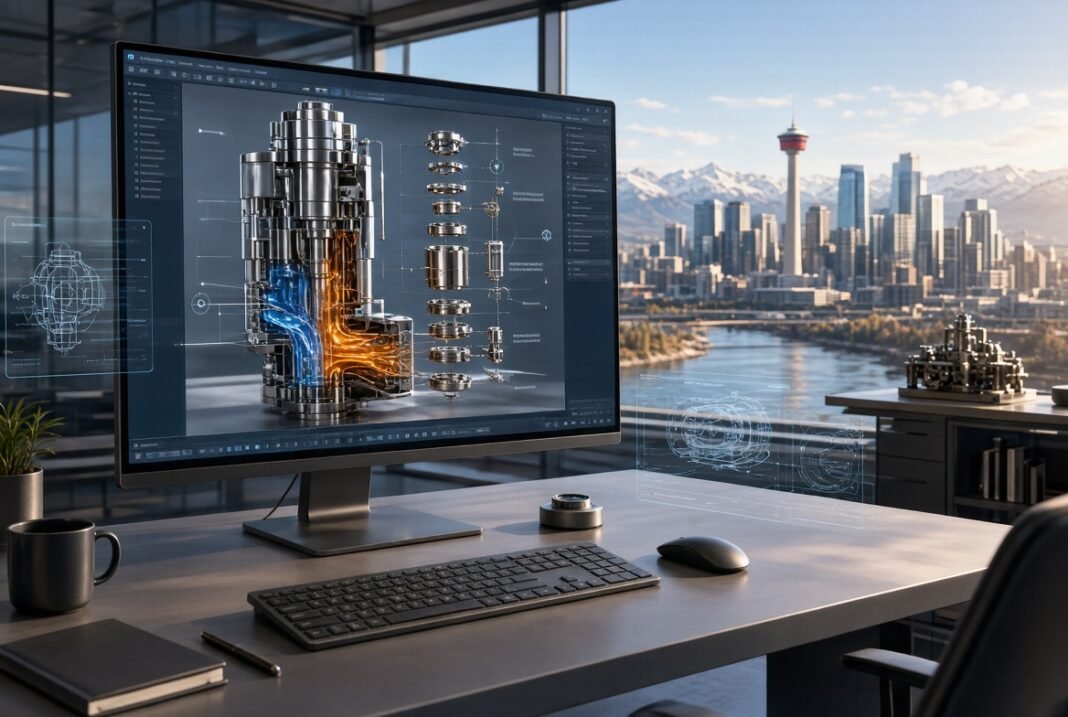


Alberta’s economy runs on complex machinery, precision engineering and processes that are difficult—or impossible—to show with a camera. Downhole tools operating kilometres underground, modular process equipment destined for remote sites, clean-tech prototypes still on the drawing board, and heavy industrial systems whose internal workings remain sealed all present the same communication problem: how do you make the invisible visible and the complicated clear?
In Calgary and across Alberta, a growing number of specialized 3D animation studios have become the answer. By turning CAD files into photorealistic animations, cutaways, exploded views and process simulations, these firms help manufacturers, energy companies and technology developers explain their products with clarity and impact that traditional photography, live video or static diagrams cannot match.
The Communication Challenge in Alberta’s Core Industries
Oil and gas remains central to the provincial economy, even as diversification accelerates into energy technology, advanced manufacturing and clean resources. Equipment in these sectors is often large, hazardous, proprietary or simply not yet built. Shipping a full-scale unit to a trade show is expensive and logistically impractical. Filming inside a pressurized system or a downhole environment is usually impossible. Technical drawings demand specialized knowledge that many decision-makers—procurement managers, investors, operators and regulators—do not possess.
The same constraints apply outside energy. Manufacturers of industrial valves, pumps, automation systems and modular plants face buyers who need to understand internal flow paths, assembly sequences and failure modes. Emerging tech firms pitching hydrogen equipment, carbon-capture modules or advanced materials must convey value before a physical prototype exists. In each case, the gap between engineering reality and audience understanding slows sales cycles, complicates training and weakens investor confidence.
How 3D Animation Closes the Gap
3D product animation solves the problem by creating a digital twin of the product that can be viewed from any angle, sectioned, exploded, animated and placed in realistic environments. Studios working with Alberta clients typically begin with the manufacturer’s native CAD data (STEP, IGES, SolidWorks or similar files). This preserves dimensional accuracy and engineering intent. From there, artists model materials, lighting and motion, then produce sequences that reveal exactly what needs to be understood:
- Internal mechanisms and fluid or gas flow paths
- Opening, closing or actuation sequences
- Exploded assemblies showing part relationships
- Installation, maintenance or operational procedures
- Product performance under simulated real-world conditions
The result can be a 30- to 90-second marketing video, a longer technical explainer, still images for catalogues and websites, interactive configurators, or training modules. Because the assets are digital, they are endlessly reusable across sales decks, websites, trade-show loops, investor presentations and operator training programs.
Calgary studios such as Electric Media have spent more than two decades producing oilfield and downhole-tool animations for energy clients, including viscosity explainers and technology highlight reels. Others, including Dante Art Studio, 3D Epix and a range of smaller specialized houses, deliver industrial product visualization, process simulations and commercial motion graphics tailored to Alberta’s manufacturing and energy-tech base. These firms understand the technical vocabulary of SAGD, downhole tools, process equipment and heavy machinery—an advantage when accuracy matters as much as aesthetics.
Practical Applications Across Sectors
In oil and gas, 3D animation routinely demonstrates how a new completion tool functions, how fluids move through a system, or how a safety mechanism operates under pressure. Sales teams use the videos at trade shows and in client meetings so that engineers and commercial buyers alike grasp the value proposition without needing a physical demonstration. Training departments employ the same assets to show correct assembly, maintenance steps and hazard scenarios without exposing workers to risk.
Manufacturers of industrial equipment use animation to differentiate their products. A cutaway of a high-performance valve or pump instantly communicates flow efficiency, sealing technology or serviceability advantages that would otherwise remain hidden inside a metal housing. For products still in development, photoreal renders and animations allow marketing and fundraising to begin months or years before the first unit is fabricated.
Clean-tech and energy-transition companies face an even steeper explanatory challenge: many of their solutions are novel. A well-crafted 3D sequence can show a modular carbon-capture unit operating in context, a hydrogen production process step by step, or the internal workings of advanced energy storage—building credibility with investors and early customers who must evaluate technology they cannot yet visit.
Architectural and real-estate visualization, while different in application, follows the same logic: complex spatial and systems relationships become understandable when rendered and animated. Several Calgary studios serve both industrial product clients and architectural markets, leveraging overlapping technical skills.
Measurable Business Benefits
The advantages are both qualitative and quantitative. Visual content improves comprehension and retention of technical information, often cited in the range of 25–40 percent relative to text or static diagrams alone. Interactive or animated product experiences have been linked to shorter B2B sales cycles—sometimes by more than 25 percent—because buyers reach confidence earlier. Companies report reduced need for expensive physical demos, lower travel and logistics costs, and consistent messaging across global teams and channels.
For products that do not yet exist, 3D animation is frequently the only viable visual proof. Investor decks, stage-gate reviews and early marketing campaigns rely on it. Once created, the digital assets continue generating value: a single high-quality model can yield multiple camera angles, configuration variants, stills and short clips optimized for different platforms.
The Calgary Advantage
Calgary’s concentration of energy, engineering and manufacturing companies has fostered a local ecosystem of 3D specialists who understand the sector’s conventions and technical demands. Studios that regularly handle CAD from Alberta clients produce more accurate results faster than generalist animation houses unfamiliar with industrial geometry or industry-specific terminology. Proximity also simplifies collaboration—engineers can review work-in-progress with local teams and iterate efficiently.
Cost structures in the Alberta market typically range from several hundred dollars for a single photoreal product render to several thousand for a multi-angle image set or a short animation, scaling upward with complexity, length and simulation requirements. Because the work starts from existing engineering data, clients avoid the expense and time of building models from scratch.
Choosing the Right Partner and Process
Successful projects share common characteristics. The studio should accept native CAD files rather than asking the client to supply screenshots or rebuild by eye. Experience in the relevant vertical—downhole tools, process equipment, heavy machinery or energy tech—reduces the risk of visual or technical inaccuracies. Clear communication about intended use (sales, training, investor relations) ensures the final deliverable matches the audience and channel.
A typical workflow moves from CAD import and model preparation through texturing, lighting, animation, rendering and final compositing or editing. Clients review at key milestones so that engineering accuracy is preserved while visual storytelling remains strong. The best results balance photorealism with clarity: unnecessary visual noise is removed so that the product’s essential story remains front and centre.
Looking Ahead
As Alberta continues to diversify and as digital sales and remote collaboration become permanent features of B2B commerce, demand for high-quality product visualization is likely to grow. Advances in real-time rendering, interactive web experiences and extended reality will expand the toolkit further, allowing buyers to explore products themselves rather than simply watching a linear video. Yet the fundamental need remains unchanged: to explain complex products clearly, accurately and persuasively.
For Alberta firms whose products are engineered to perform in demanding environments, 3D animation has become an essential communication tool. It turns engineering data into shared understanding, shortens the distance between innovation and adoption, and gives technical products the visual voice they need in a competitive marketplace. In Calgary and across the province, specialized studios stand ready to make the invisible visible—one precise, compelling animation at a time.