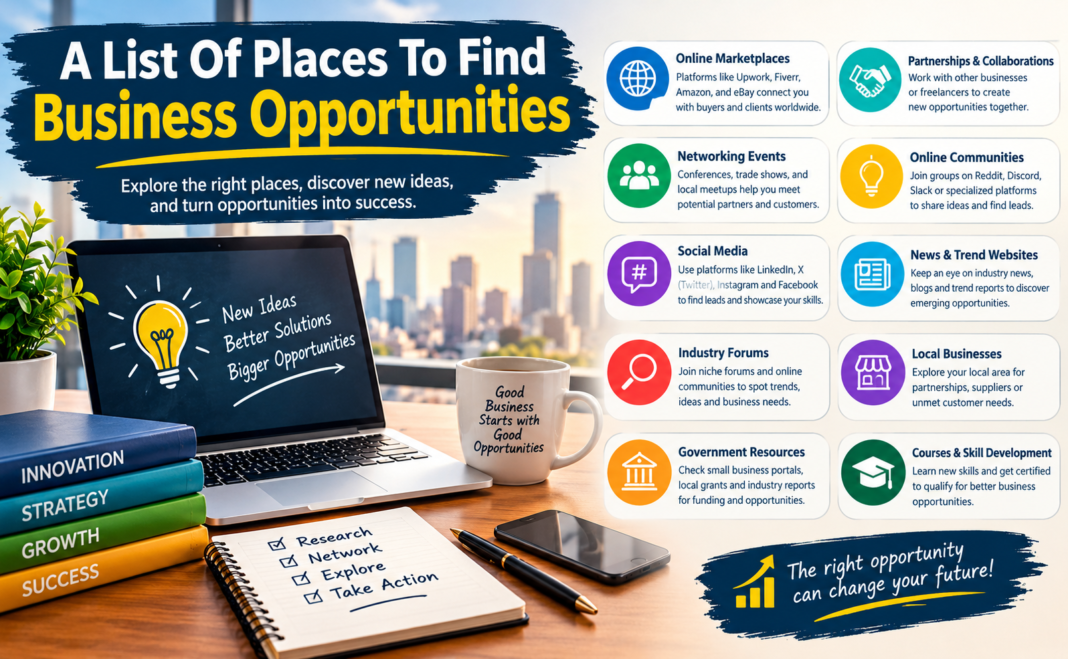


Every successful venture begins with a single moment of recognition: the instant an entrepreneur spots a gap between what exists and what is needed. The challenge is not usually a shortage of ambition but a shortage of direction. Opportunities are rarely announced with fanfare. They hide in complaints, inefficiencies, regulatory shifts, demographic changes and quiet corners of the economy that most people walk past without a second glance.
This article maps the most productive places to look. It is organised by environment rather than industry, because the environment determines what kind of opportunity you are likely to find. Some venues reward patience and relationship building, others reward speed and technical literacy. Knowing where to look, and why that place produces opportunity, is the first competitive advantage you can give yourself.
Your Existing Network
The most underrated source of business opportunity sits in your phone. Former colleagues, classmates, suppliers, clients and acquaintances already know and trust you, which removes the single biggest barrier to any deal. Trust compresses sales cycles dramatically.
The practical technique is to stop asking for favours and start asking for information. A message that says “I am exploring a move into logistics software and would value twenty minutes of your perspective” generates far more replies than a pitch. People enjoy being consulted; they resist being sold to. Over a series of these conversations, patterns emerge. Three different contacts mention the same frustration, and that repetition is your signal.
Industry Trade Shows and Conferences
Trade shows remain one of the richest hunting grounds available. In a single afternoon you can observe an entire sector’s competitive landscape, pricing structures, product gaps, marketing language and unmet customer complaints simultaneously. Nowhere else offers that density of information.
To extract real value, abandon the habit of walking the floor collecting tote bags. Instead, book meetings in advance, attend the fringe sessions where smaller players speak candidly, and spend time at the stands of companies adjacent to your interest. The most revealing conversations often happen at the coffee queue rather than the keynote. Follow up within forty-eight hours while your face is still memorable.
Government and Regulatory Portals
Boring, unglamorous and extraordinarily profitable. Government websites publish tenders, grants, licensing requirements, consultations and legislative timetables. Each of these documents is effectively a list of problems that someone will be paid to solve.
When a new regulation is announced, an entire compliance industry materialises almost overnight. Businesses need consultants, software, training and audits. The entrepreneurs who read the consultation papers eighteen months before the rules take effect enjoy a head start that no amount of marketing can buy. Set alerts on procurement portals, subscribe to departmental newsletters and read the impact assessments that accompany new legislation.
Online Marketplaces and Review Platforms
Amazon, Etsy, eBay, app stores and review sites are vast, free databases of customer dissatisfaction. Read the one-star and two-star reviews of popular products. The complaints cluster with remarkable consistency: poor instructions, flimsy materials, slow delivery, unhelpful support, confusing interfaces.
Those clusters are product roadmaps. A supplement brand with hundreds of reviews complaining about clumping powder has told you exactly what to fix. A software tool criticised for its onboarding has handed you a positioning strategy. Review mining is inexpensive, immediate and relentlessly empirical.
Professional Associations and Industry Bodies
Associations exist to serve their members, which means they maintain directories, run events, publish research and maintain committees. Membership, or even attendance at open events, gives you access to people who have opted in to thinking about their industry’s future.
Committee meetings are particularly valuable. They are where problems are discussed before solutions are formalised, and where you can volunteer your way into a position of influence at negligible cost.
B2B Procurement and RFP Channels
Large organisations buy constantly through structured processes. Public sector bodies publish tenders openly, and many private companies maintain supplier portals where they post requirements. Even if you never win a major contract, reading these documents teaches you what buyers actually specify, how they score bids and where incumbents are vulnerable.
Subcontracting is a smart entry route. Prime contractors frequently need specialist partners, and becoming a reliable subcontractor builds the track record required to bid directly later.
Universities, Research Labs and Accelerators
University technology transfer offices hold patents, research findings and prototypes that are commercially undeveloped. Licensing an existing technology can compress years of research and development into months.
Accelerators and incubators provide a related benefit: cohorts of founders openly discussing what is broken. Mentors, demo days and investor office hours all generate intelligence. You do not always need to be a participant; many programmes welcome mentors, judges and sponsors.
Local Business Communities and Chambers of Commerce
Geographic proximity still matters. Chambers of commerce, business improvement districts and local networking groups surface opportunities that never reach national visibility: a retiring owner with no succession plan, a neighbourhood underserved by a particular retail category, a supplier relocating and disrupting a regional chain.
Succession-driven acquisitions are especially attractive. Thousands of profitable small businesses change hands each year because the founder wants to retire, and buyers who show up prepared often secure excellent terms.
Job Boards and Freelance Platforms
Job advertisements are public statements of pain. When a company hires three marketing managers in a quarter, it is scaling. When it repeatedly advertises the same role, it has a retention problem worth solving. When a niche skill appears in hundreds of listings at rising salaries, a training or staffing business becomes viable.
Freelance platforms add a second layer: buyers describe exactly what they need and how much they will pay. Sorting these requests by category reveals demand patterns, seasonal rhythms and price ceilings.
Competitor Customers
A disciplined, ethical practice: examine your competitors’ customers and ask what those customers wish existed. Churn is never random. If a notable share of a rival’s clients are frustrated, there is a segment seeking an alternative, and their complaints constitute a specification.
International Markets
Ideas validated in one market frequently travel well. Business models mature in Scandinavia, Singapore or the United States often arrive in other regions years later. Studying foreign markets reveals what is coming next rather than what is already crowded.
Localisation is the value you add. Payment methods, regulations, languages and cultural expectations all require adaptation, and that adaptation is defensible work.
Emerging Technology Platforms
Every significant technology shift creates a service economy around it. Cloud computing produced consultancies; smartphones produced app agencies; artificial intelligence is producing integration, governance, training and audit specialists. Early entrants to a platform’s ecosystem often capture outsized positions before the market matures.
Final Thoughts
Opportunity is not scarce; attention is. The places listed above all share one characteristic: they generate unfiltered evidence of what people want and what currently fails them. Reviews, tenders, consultations, complaints, job adverts and hallway conversations are all forms of market research that cost nothing but vigilance.
The most effective approach combines several sources. A regulatory change spotted in a government portal, cross-checked against competitor reviews, validated through your network, is a dramatically stronger proposition than a hunch from a single article. Build a lightweight routine: one hour a week reading tenders, one networking conversation a fortnight, one review-mining session a month.
Then act on the smallest possible version. A landing page, a pilot client, a single subcontracted project. Opportunity does not reward the person who thinks longest. It rewards the person who converts observation into an offer fastest, then learns from real customers rather than imagined ones. The places to look are plentiful. The scarce resource is the discipline to look regularly, and the courage to respond when you find something worth pursuing.