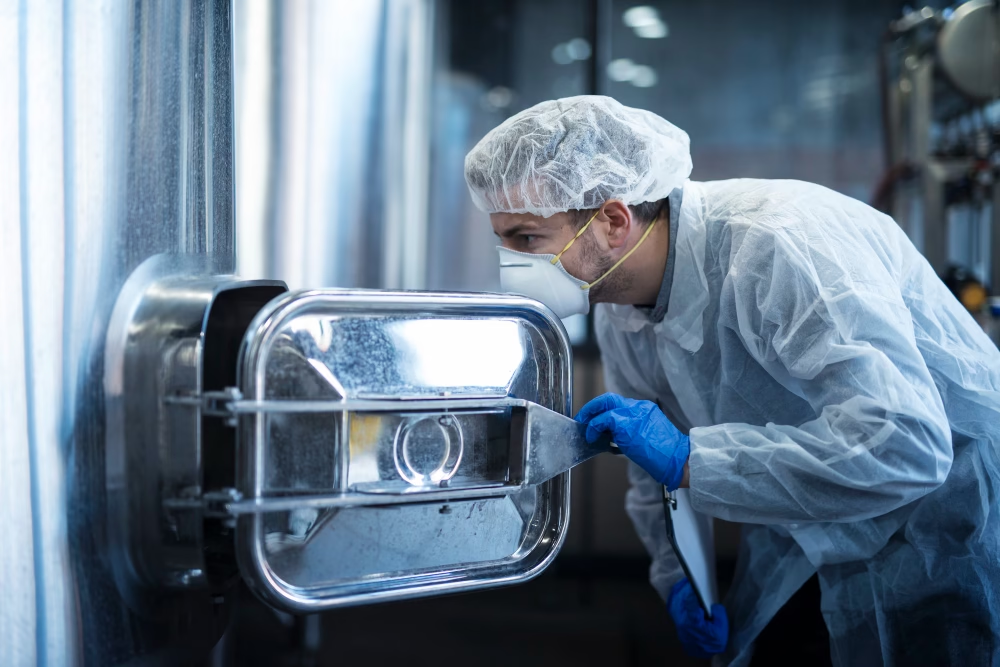


In the rapidly evolving landscape of solar cell manufacturing, the efficiency and reliability of production processes are paramount. One critical step in this chain is the drying of metallization pastes, which are applied to silicon wafers to create conductive pathways essential for photovoltaic performance. Traditional drying methods have long struggled with challenges such as contamination, high maintenance requirements, and limitations in handling modern high-VOC (volatile organic compound) pastes at increased production speeds. Enter Dritsch™ Ovens, a groundbreaking solution developed by Despatch Industries, now part of ITW EAE. These advanced dryers represent a leap forward in hybrid heating technology, specifically designed to optimize the drying of metallization pastes like silver and aluminum in solar cell production lines.
Dritsch™ Ovens address key industry pain points by decoupling VOC removal from binder burn-off, enabling a more controlled and efficient drying process. This innovation not only enhances cell efficiency but also reduces operational costs and environmental impact. As solar energy demand surges globally, with the International Energy Agency projecting a tripling of photovoltaic capacity by 2030, technologies like Dritsch™ are pivotal in scaling production without compromising quality. This article delves into the technology, features, benefits, and real-world applications of Dritsch™ Ovens, highlighting their role in advancing sustainable energy manufacturing.
The Technology Behind Dritsch™ Ovens
At the core of Dritsch™ Ovens is a unique hybrid heating technology that combines advanced thermal management with sophisticated air flow systems. Unlike conventional dryers that rely solely on convective or infrared (IR) heating, Dritsch™ integrates both, allowing for precise control over the drying environment. This hybrid approach decouples the processes of solvent evaporation and binder curing, preventing premature burn-off that can lead to defects in the metallized layers.
The system employs a single-pass heated process gas flow, directing air from the dryer’s ends toward the center. This design effectively contains smoke and vapors, ensuring complete solvent removal while minimizing contamination risks. An integral thermal oxidizer handles VOC abatement at the point of use, eliminating the need for additional facility exhaust systems. This is particularly crucial for modern metallization pastes, which contain higher VOC levels to improve printability and adhesion but pose challenges in traditional setups.
Furthermore, Dritsch™ enables low-temperature drying, operating at peak temperatures as low as 115°C for silver pastes and 130°C for aluminum. This is a significant departure from legacy dryers that often require temperatures exceeding 200°C, which can cause voids in the paste due to uneven binder behavior. By expanding the process window by up to 70°C for silver and 50°C for aluminum, Dritsch™ ensures consistent drying across a broader range of conditions, accommodating variations in paste formulations and belt speeds. Technical graphs from performance studies illustrate this advantage, showing Dritsch™ achieving over 34% higher drying efficiency at lower temperatures compared to traditional methods.
This technology is seamlessly integrated with major metallization printer lines, such as those from Baccini or Applied Materials, facilitating high-throughput operations. With belt speeds supporting up to 400 wafers per hour in single-lane configurations, Dritsch™ aligns with the industry’s push toward gigawatt-scale production facilities.
Key Features of Dritsch™ Ovens
Dritsch™ Ovens boast an array of features tailored for industrial robustness and ease of use. The maintenance-free design is a standout, virtually eliminating cleaning requirements. In pilot installations across three production sites, the ovens processed over 10 million cells without a single cleaning cycle over 12 months, thanks to the advanced air flow management that prevents residue buildup.
Air flow is optimized through a patented system that uses heated process gas in a controlled manner, removing over 400kg of solvents per month in a single lane without escaping into the environment or contaminating cells. The hybrid heating incorporates thermal surfaces that provide uniform heat distribution, reducing hot spots and ensuring even drying. Additionally, the integral thermal oxidizer not only abates VOCs but does so efficiently, complying with stringent environmental regulations like Germany’s TA Luft standards.
Other notable features include flexible drying profiles for various paste types, real-time monitoring via advanced sensors, and modular construction for easy integration into existing lines. The ovens support both single- and dual-lane configurations, with options for extended cooling zones to prevent thermal shock to delicate wafers. Specifications typically include a footprint of approximately 3-5 meters in length, power consumption optimized for energy efficiency, and compatibility with paste viscosities ranging from 100-300 Pa·s.
Security and safety are prioritized with features like automatic shutdown protocols for VOC overloads and ergonomic access points for minimal downtime during inspections. These elements make Dritsch™ not just a dryer, but a comprehensive solution for modern metallization challenges.
Benefits in Solar Cell Manufacturing
The adoption of Dritsch™ Ovens yields multifaceted benefits in solar cell manufacturing. Foremost is enhanced cell efficiency: by avoiding voids and ensuring complete solvent removal without binder degradation, Dritsch™ reduces the incidence of low-efficiency cells by up to 1.7%. This translates to higher yields and better overall module performance, critical in a market where every percentage point in efficiency can significantly impact profitability.
Cost savings are another major advantage. The maintenance-free operation slashes labor and downtime costs, with no need for frequent cleanings that plague traditional dryers. Energy efficiency is improved through the hybrid system, which requires less power for equivalent drying rates. Moreover, the low-temperature capability opens the process window, allowing manufacturers to experiment with innovative paste formulations that might otherwise be incompatible.
Environmentally, Dritsch™ excels by containing and abating VOCs on-site, reducing emissions and eliminating the need for external scrubbers. This aligns with global sustainability goals, such as those outlined in the EU’s Green Deal, and helps manufacturers achieve certifications for eco-friendly operations.
In terms of scalability, Dritsch™ supports faster belt speeds without compromising quality, enabling production ramps to meet surging demand. For instance, in high-volume lines, it handles increased paste VOC levels associated with finer grid lines, which are essential for next-generation PERC (Passivated Emitter Rear Cell) and TOPCon (Tunnel Oxide Passivated Contact) technologies.
Maintenance and Efficiency
Maintenance has historically been a bottleneck in metallization drying, with traditional systems requiring weekly cleanings due to residue accumulation. Dritsch™ revolutionizes this by design: its air flow and thermal oxidizer prevent buildup, ensuring contamination-free operation for extended periods. Pilot data confirms zero contamination of cells, dryers, or surroundings, even after processing millions of units.
Efficiency metrics are impressive. The enlarged process window—50°C wider than competitors—provides flexibility in temperature settings, reducing defects from paste inconsistencies. Low-temperature drying preserves paste integrity, minimizing series resistance increases from voids, as evidenced by comparative studies. Overall, Dritsch™ delivers a 34% boost in drying efficiency, directly contributing to throughput improvements.
Case Studies and Performance Data
Real-world deployments underscore Dritsch™’s value. In three solar manufacturing facilities, the ovens maintained peak performance without maintenance interventions, processing over 10 million cells. One case showed a 1.7% reduction in low-efficiency cells, attributed to superior drying uniformity.
Performance graphs highlight advantages: for silver paste, Dritsch™ achieves full drying at 115°C, expanding the viable temperature range by 70°C. For aluminum, it’s 50°C wider, with data points showing higher solvent removal rates at lower temps. These metrics validate Dritsch™’s edge in high-stakes production environments.
Future Prospects
Looking ahead, Dritsch™ is poised to evolve with emerging solar technologies like heterojunction (HJT) cells, which demand even finer metallization. Potential enhancements include AI-driven process optimization and integration with Industry 4.0 systems for predictive maintenance. As paste formulations advance toward lower silver content for cost reduction, Dritsch™’s flexible drying will be invaluable.
Conclusion
Dritsch™ Ovens exemplify innovation in metallization paste drying, offering unmatched efficiency, maintenance-free operation, and environmental benefits. By addressing core challenges in solar manufacturing, they pave the way for higher-quality, cost-effective photovoltaic production. As the world transitions to renewable energy, technologies like Dritsch™ will be instrumental in powering a sustainable future.