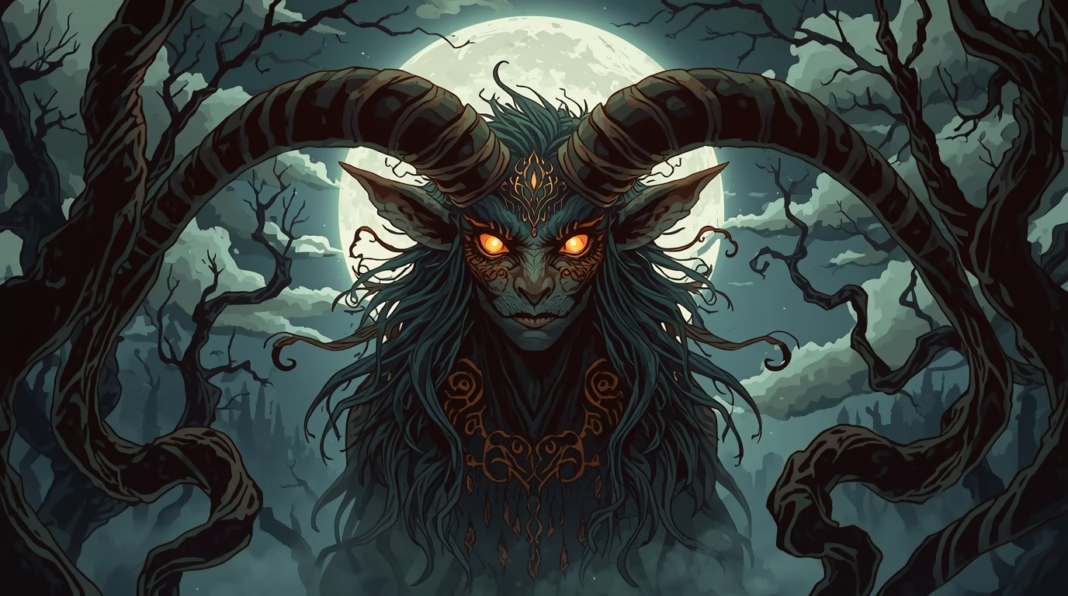


The night holds many secrets, and for centuries, storytellers have populated the darkness with figures of desire and danger. Among the most enduring of these entities is the succubus, a seductive demon that visits people in their sleep. In Hungarian, this creature is known as the “Szukkubusz.” This term, directly translating to “succubus,” opens a door to a world of ancient fears, complex mythology, and cultural fascination that spans from ancient Mesopotamia to modern cinema. Exploring the Szukkubusz means delving into the very heart of human anxieties about desire, spirituality, and the unknown forces that move in the shadows.
Etymology and Meaning What’s in a Name?
To understand the Szukkubusz, we must first look at its Latin root. The word “succubus” originates from the Late Latin term succuba, which means “a prostitute.” This is derived from the verb succubare, a compound of “sub-” (meaning “under”) and “cubare” (meaning “to lie”). The name itself paints a vivid picture: a being that lies beneath another. This etymology is crucial because it defines the creature’s primary method of interaction—visiting a person, typically a man, in their sleep and lying with them.
The Hungarian term “Szukkubusz” is a direct adoption of this Latin concept, integrated into the language to describe this specific type of supernatural entity. Its meaning remains identical, carrying all the historical and mythological weight of its origin. The name inherently links the creature to themes of seduction, sin, and a dangerous, otherworldly form of intimacy. It is not just a name but a description of its perceived function.
Origins in Ancient Folklore and Early Beliefs
The idea of a supernatural entity that engages in nocturnal relations with humans is not a medieval invention. Its roots stretch back to the earliest civilizations. In ancient Mesopotamian mythology, spirits known as the lilu (for males) and lilitu (for females) were said to roam the night, preying on sleeping individuals. The lilitu are often considered the earliest precursors to the succubus legend.
The most famous of these figures is Lilith. In Jewish folklore, particularly in the medieval text Alphabet of Ben Sira, Lilith is portrayed as the first wife of Adam. Unlike Eve, who was created from Adam’s rib, Lilith was made from the same earth as him. When she refused to be subservient to Adam, demanding equality, she fled the Garden of Eden. According to the legends, she was then cursed to become a mother of demons and a prowler of the night, stealing the breath of infants and seducing men in their sleep. This powerful and independent figure became the archetypal succubus, a symbol of feminine power that exists outside of traditional patriarchal control. Her story laid the foundational folklore for the demons of desire that would haunt the European imagination for centuries.
The Succubus in Medieval and Religious Texts
It was during the Middle Ages in Europe that the concept of the succubus and its male counterpart, the incubus, truly crystallized. Amidst a backdrop of intense religious fervor and superstition, these demons became a popular explanation for a range of phenomena, from nocturnal emissions and sleep paralysis to unexplained feelings of lust and guilt.
Christian demonology provided a structured framework for understanding these beings. The influential 15th-century text, the Malleus Maleficarum (or “The Hammer of Witches”), dedicated significant sections to discussing succubi and incubi. Written by the German Catholic clergyman Heinrich Kramer, this witch-hunting manual described these demons in terrifying detail. According to the Malleus, a succubus would seduce a man and collect his semen. It could then transform into an incubus, using the stolen seed to impregnate a woman. The resulting child, known as a cambion, was believed to be half-human, half-demon, and prone to great evil. The legendary wizard Merlin is one of the most famous figures purported to be the offspring of such a union.
These religious interpretations framed the succubus not merely as a mischievous spirit but as an agent of Hell. Her purpose was twofold: to lead souls to damnation through the sin of lust and to propagate a demonic bloodline on Earth. This theological viewpoint transformed the succubus from a figure of folklore into a serious threat to one’s spiritual salvation, making her a subject of both fear and intense scholarly debate among theologians.
Portrayals in Legends and Stories Across Cultures
While the core concept of the Szukkubusz or succubus remained consistent, her portrayal varied across different cultural legends.
In pan-European folklore, she often took the form of a breathtakingly beautiful woman, appearing in dreams as the embodiment of a man’s deepest desires. Her allure was her primary weapon, a honeyed trap that promised ecstasy but delivered spiritual ruin. Some tales described her as having demonic features, such as small horns, a forked tail, or cloven hooves, which she would skillfully conceal until her victim was ensnared. Other stories depicted her as a more tragic figure, a lost soul or a cursed woman bound to her predatory nature against her will.
Slavic mythology features the Rusalka, a water spirit who shares some traits with the succubus. Often the ghost of a young woman who died violently, particularly by drowning, the Rusalka would lure men—often former lovers—to the water’s edge with her enchanting songs and beauty before drowning them. While not a demon in the Christian sense, her seductive and deadly nature overlaps with the succubus archetype.
In Hungarian folklore itself, the Lidérc is a supernatural creature with characteristics similar to a succubus or incubus. The Lidérc could be a fiery bird or a lover who visits its chosen human at night, bringing wealth and success but slowly draining their life force in return. This highlights a common theme in these legends: the relationship with the supernatural entity is a Faustian bargain, offering temporary pleasure or gain at the cost of one’s ultimate well-being.
The Modern Succubus From Monster to Metaphor
In the centuries since the height of the witch trials, the Szukkubusz has undergone a significant transformation. With the rise of science and psychology, phenomena once attributed to demons found rational explanations. Sleep paralysis, for example, is now understood as a neurological event, yet its terrifying sensations—a heavy weight on the chest, an inability to move, and the presence of a shadowy figure—perfectly match historical descriptions of succubus attacks.
As belief in literal demons waned, the succubus evolved in literature, art, and media. She transitioned from a purely malevolent monster to a more complex and often sympathetic character. The Romantic movement of the 19th century began to explore her as a figure of tragic, forbidden love. John Keats’s poem “La Belle Dame sans Merci” tells of a knight bewitched by a fairy-like woman who leaves him desolate, a classic succubus narrative re-imagined with emotional depth.
In the 20th and 21st centuries, the succubus has become a staple of the fantasy and horror genres. She appears in everything from video games like The Witcher and Dungeons & Dragons to television shows like Supernatural and Chilling Adventures of Sabrina. Modern depictions often explore themes of sexuality, power, and morality. Sometimes she is an anti-hero, using her seductive powers for her own agenda, which may or may not align with the forces of evil. In other interpretations, she is a tragic figure struggling with her demonic nature or even a powerful protagonist who reclaims the narrative of female sexuality that was once used to demonize her.
The modern Szukkubusz is less a threat to one’s immortal soul and more a potent metaphor. She represents untamed desire, the power of female sexuality, and the dangerous allure of the forbidden. She is a symbol of the tension between our primal instincts and our societal rules, a creature born from our deepest fears and most powerful longings. From ancient Mesopotamian spirits to complex characters in today’s media, the journey of the Szukkubusz reflects humanity’s ever-changing understanding of itself.